Category: Blog

  • Validate Your Micro-SaaS Idea Using Your Blog: Finding Product-Market Fit

    Validate Your Micro-SaaS Idea Using Your Blog: Finding Product-Market Fit

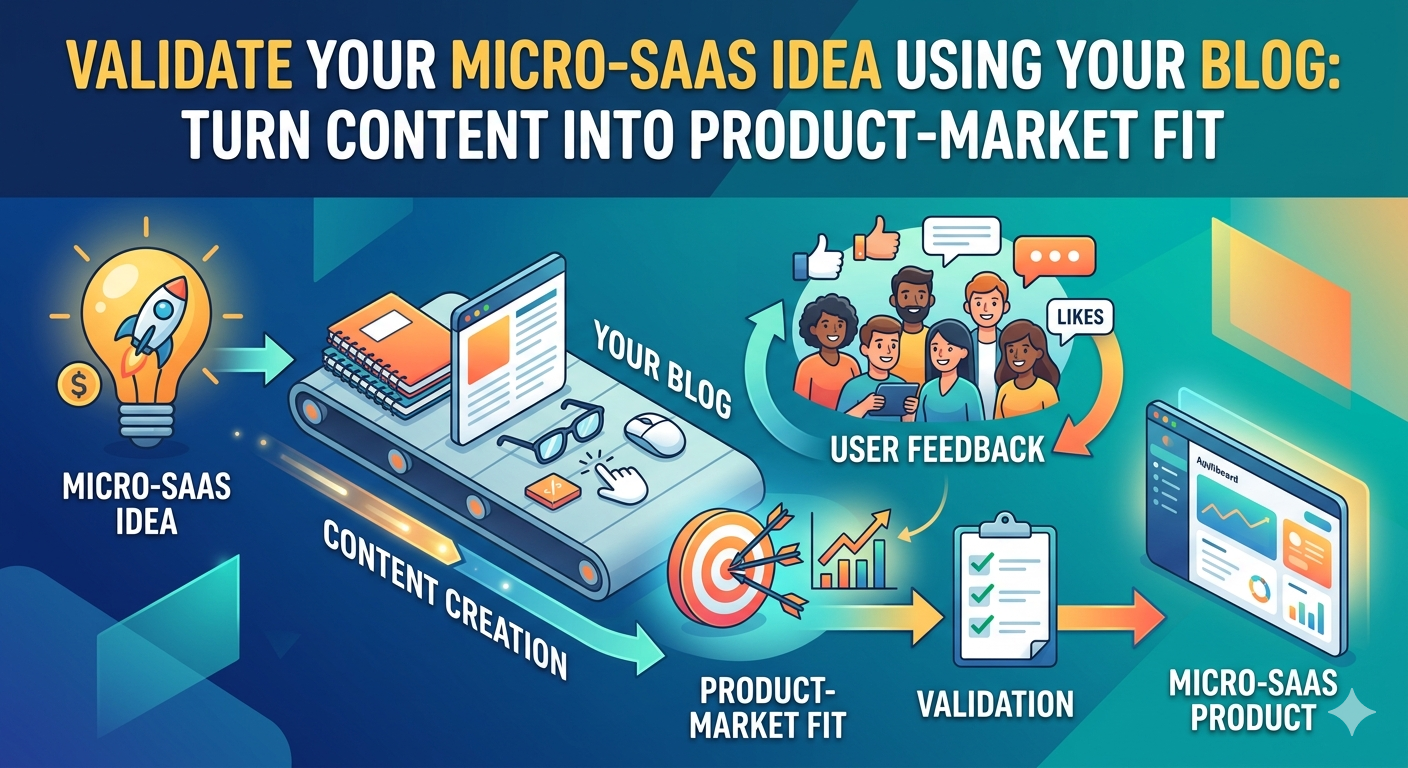
    OK so think about this..Let’s say you’ve got a blog that’s actually getting some amount of traction. People are reading your posts, leaving comments, maybe even signing up for your email list. But what if your audience isn’t just for about numbers? What if it’s your secret weapon for building a micro-SaaS that actually sells?

    Most creators approach micro-SaaS all wrong. They lock themselves in a room for 3 months, build what they think is the perfect tool, then launch to crickets. Meanwhile, they’ve been ignoring the most powerful validation tool they already own: their blog / online audience.

    The Content-First Validation Method

    Let me explain how this works for ya.. Your blog isn’t just a content channel, it’s a built-in focus group / feedback loop / early adopter network all rolled into one. Every post you write is actually a low-cost experiment in what resonates with your audience.

    When you notice certain topics consistently getting more engagement, comments, or shares, that’s not just algorithmic luck. That’s your audience telling you what problems they actually care about solving. In the world of micro-SaaS, solving real problems is literally the only thing that matters.

    Mining Your Content for Gold

    Here’s how to turn your existing blog into a idea-validation machine:

    First, go back through your top 10 performing posts (by time on page, comments, or social shares). Look for patterns in the questions people are asking in the comments. Are they repeatedly asking for tools, templates, or checklists related to a specific topic?

    Second, pay attention to which posts generate the most email signups when you offer a related lead magnet. If your post about “systemizing your client onboarding” gets 5x more newsletter subs than your post about “trendy marketing tactics,” that’s a huge signal.

    Third, notice which topics you keep returning to in your own writing. If you find yourself referencing the same framework or process over and over, that’s probably because it’s genuinely useful — not just to you, but to your readers who keep engaging with those posts.

    Let me give you a real world example: lets say you run a blog about uhhh.. coffee shop management. You notice your posts about inventory tracking and waste reduction or whatever, consistently get the most engagement from viewers. Comments keep asking: “Is there a simple tool for tracking daily bean usage?” or “How do you actually calculate waste percentage without it being a huge pain?”

    That’s not just engagement my guy, that’s a product opportunity screaming for attention! Your audience has literally told you they want a tool to solve this specific, painful problem. All you have to do is build the simplest possible version and offer it to them.

    From Blog Post to Micro-SaaS: Here’s My Process

    Here’s how to actually do this without over-complicating it. FIRST let’s find the idea.. Here’s how I’d do it:

    • Start with your highest-engagement content — the post that consistently gets the most comments, shares, or time on page
    • Alternatively simply audit your top 5 posts by engagement and note the recurring questions or pain points in comments
    • Extract the core problem — what specific task or frustration are people repeatedly mentioning?
    • Create a simple survey asking your email list which of 3 potential tools they’d pay for and why
    • Write a follow-up post proposing your micro-SaaS idea and measure the response (comments, shares, email clicks)

    Steps To Validate Your Idea

    After finding your idea, here’s exactly how I would start validating it using your blog:

    • Build the absolute minimum viable version — could be a simple Airtable base, a Google Sheets template with some formulas, or a basic Softr tool
    • Offer it to your blog audience first — make them feel like insiders getting early access
    • Charge from day one — even if it’s just $5-$20 to start, this validates that people will actually pay
    • Use their feedback to improve — every suggestion from your early users becomes your product roadmap. Iterate based on real usage.. not what you think they want, but what they actually use

    The Real Advantage: Trust Already Built

    Here’s the kicker that most people miss about using this methodology… when you launch a micro-SaaS to your blog audience, you’re not starting from zero. You’ve already spent months or years building credibility through your content. They know your voice, they’ve seen your expertise, and they’ve hopefully gotten value from your content already. So it’s a natural evolution to go from viewer to customer!

    That trust is worth more than any amount of paid advertising. It means your early adopters aren’t just buying a tool, they’re buying from someone they already believe in. And in the early days of a micro-SaaS, having users who will give you honest feedback and tell others about your tool is worth its weight in gold.

    Stop Guessing, Start Listening

    The beautiful thing about this approach is that it turns validation from a scary, uncertain process into something almost effortless. You’re not guessing what people want — you’re listening to what they’ve already told you through their engagement with your content.

    Your blog audience isn’t just some obscure number. They’re your built-in focus group, your beta tester network, and your first paying customers.. all in one convenient package. Stop treating your blog as just a content channel and start seeing it for what it really is… the most powerful validation tool you’ll ever own for your micro-SaaS ideas!

    So next time you’re wondering whether that tool idea you’ve been toying with is worth building, don’t lock yourself away to perfect it in isolation. Look at your blog analytics, read those comments, and let your audience tell you the answer.

    I hope this helped, seeya!
  • The Micro-SaaS Profit Stack: Building Multiple Tiny Profitable Tools Instead of One Large App

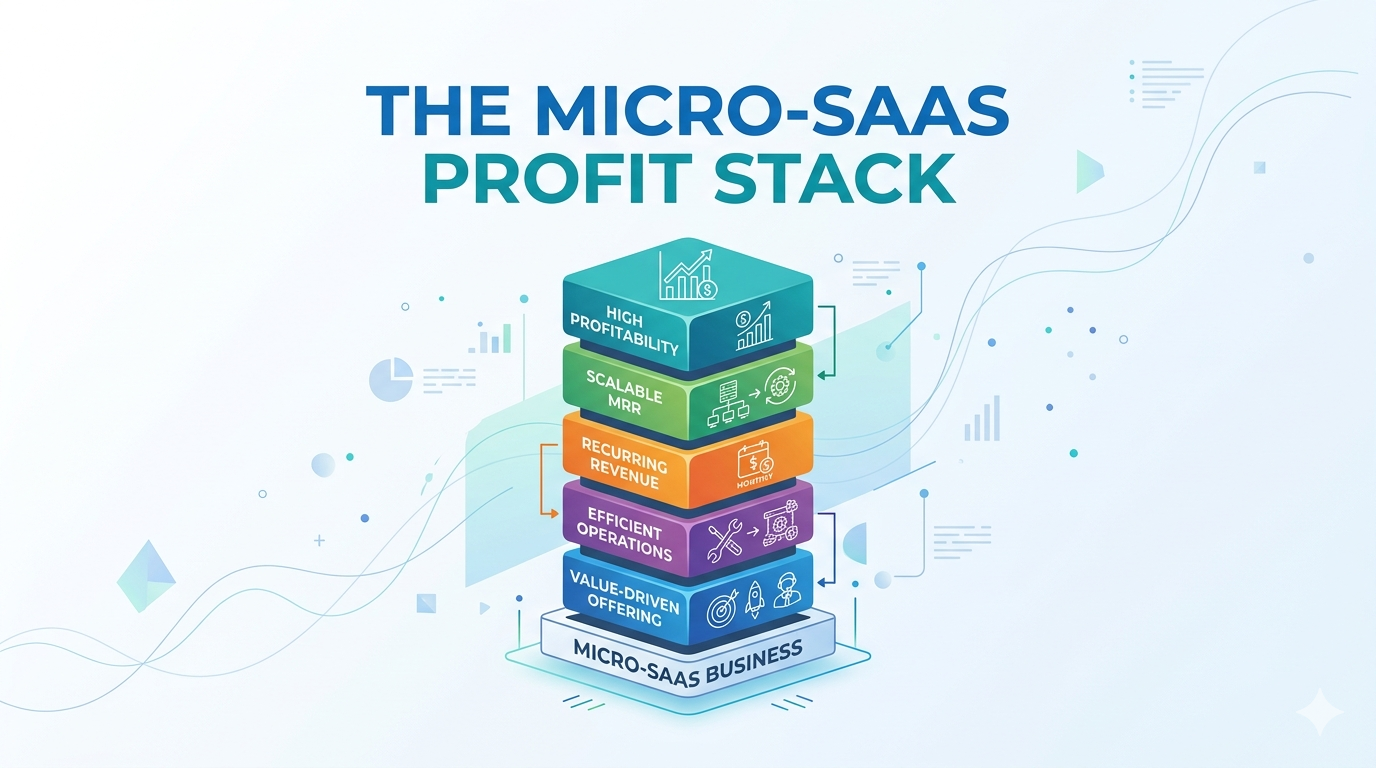
    The Micro-SaaS Profit Stack: Building Multiple Tiny Profitable Tools Instead of One Large App

    Just for a second, imagine you’re trying to build a SaaS product. You’ve got this grand vision of an all-in-one platform that does everything for your niche audience..

    But here’s the thing — that “everything” app is probably going to kill your profitability before you even launch.

    What if building multiple tiny, focused tools actually makes more money than building one complex beast?

    Let me explain the problem with the “one big app” approach most founders fall into. It’s what i call The Complexity Trap — where you keep adding features because “it would be nice to have” or “our competitors have it.”

    Before you know it, you’re spending 80% of your time on edge cases, integrations, and maintaining code that maybe 5% of your users actually use.

    Your development slows to a crawl, your hosting costs creep up, and your profit margins? They get squeezed right out of existence.

    Plus, when something breaks (and it will), the whole app goes down. Not ideal when you’re trying to run a profitable business.

    i’ve seen this happen so many times with talented builders who just couldn’t resist adding “just one more feature.”

    The Profit-Per-Tool Mindset

    Instead of chasing one big product that tries to do everything, think about building a stack of tiny tools — each one laser-focused on solving a single painful problem for a specific group of people.

    Each tool in your stack should be profitable on its own. Not “profitable someday at scale” — profitable right now with a small, dedicated user base.

    Let’s say you’re targeting local contractors. Instead of building one contractor management suite that does estimating, invoicing, scheduling, and CRM.. you could build:

    • A simple job estimating tool that lets contractors create professional quotes in 2 minutes
    • A invoice tracker that sends automatic payment reminders via SMS or email
    • A material cost calculator that updates with local supplier pricing from Home Depot or Lowe’s

    Each solves one problem well. Each can be marketed, sold, and supported independently. And crucially — each can be profitable with just hundreds of customers paying $10-30/month.

    i know what you’re thinking — “but won’t that be more work to maintain multiple tools?” Actually, no. Because each tool is so simple, updates and bug fixes take minutes instead of days. You can literally build and launch a new micro-tool in a weekend using tools like Softr, Airtable, and Stripe.

    Vertical Stacking Within Your Niche

    This is where the personal niche monopoly concept really shines. You’re not just building random tools — you’re building a vertical stack that owns different layers of the same niche workflow.

    Think about it like this: your potential customer has a journey from problem to solution. At each step, there’s an opportunity to provide value with a focused tool.

    For example, in the home services niche:

    1. Lead capture tool – helps contractors get more job inquiries from their website (think simple Typeform or Tally integration)
    2. Estimating tool – turns those leads into professional quotes fast (maybe built with Carrd and Stripe)
    3. Scheduling tool – manages their crew and job timelines (Google Calendar integration + custom interface)
    4. Follow-up tool – automates requests for reviews and referrals (Zapier + Gmail automation)

    Each tool addresses a different stage of the customer journey. You can cross-sell between them naturally (“Hey, since you’re using our estimating tool, you might love our scheduling tool for managing those jobs you just quoted!”).

    And here’s the kicker — when you own multiple touchpoints in your customer’s workflow, you become much harder to replace. They’re not just buying a tool; they’re buying part of their business infrastructure.

    i’ve watched contractors stick with tools for years not because they’re the fanciest, but because they’re deeply embedded in how they run their daily operations.

    The 20x Profit Validation Rule

    Remember from the MVS framework that the goal isn’t 100K signups — it’s 100 paying customers who love what you built. With a micro-SaaS stack, you apply this rule to each tool individually.

    Your validation process looks like this:

    1. Identify one specific, painful problem in your niche
    2. Build the absolute simplest version that solves it (could even be a manually delivered service at first)
    3. Find 20 people who would pay at least 5x what you plan to charge
    4. If you can’t get those commitments, pivot or kill the idea fast

    Let’s say you’re thinking about a tool for coffee roasters to track batch consistency. Instead of building a full-featured roasting log with social sharing, analytics dashboards, and mobile apps.. you start with a simple Google Sheet template that calculates roast deviation percentages.

    You show it to 20 coffee roasters and ask: “Would you pay $10/month for this if it saved you from ruining one batch per month?” If 10+ say yes enthusiastically, you’ve got validation. If not, you iterate or move on.

    This approach keeps your development focused and your risk low. You’re not spending months building features nobody asked for — you’re proving profitability before you write much code at all.

    i like to use Gumroad for quick validation — you can sell access to a Notion template or Airtable base in under an hour and see if people will actually pay for your solution.

    The Flywheel Effect of Multiple Tools

    This ties back to the creator flywheel concept, but applied to your tool stack. Each profitable tool in your portfolio creates opportunities for the others.

    Here’s how it works in practice:

    • Your estimating tool builds an email list of contractors who need job-related solutions (you collect emails with a free quote template)
    • When you launch your invoicing tool, you already have a warm audience to sell to (you email your estimating tool users about the new launch)
    • Those invoicing tool users become ideal customers for your upcoming scheduling tool (they’re already paying you and trust your brand)
    • Each tool launch gets easier because you’re not starting from zero (you have existing customers, testimonials, and case studies)

    Plus, you can bundle your tools strategically. Maybe you offer:

    • Estimating tool alone: $15/month
    • Estimating + Invoicing bundle: $25/month (save $5)
    • Full stack (all 4 tools): $40/month (save $20)

    Suddenly your average revenue per user goes up, your churn goes down (because leaving means giving up multiple tools), and your marketing becomes more efficient.

    It’s not just about having multiple income streams — it’s about creating a portfolio where the whole is worth more than the sum of its parts.

    i’ve seen this work beautifully with niche tools serving specific industries like HVAC technicians, tattoo artists, or food truck owners.

    Real Tools You Can Use Today

    Let’s get practical — here are actual platforms you can use to build and launch these micro-tools without writing complex code:

    For the tool itself:

    • Softr + Airtable – turn a spreadsheet into a functional web app with user accounts and payments
    • Bubble – more powerful but still visual programming for complex logic
    • Carrd + Stripe – for ultra-simple one-page tools with payment processing
    • Notion + Super.so – turn a Notion database into a public-facing tool or directory

    For automation and integrations:

    • Zapier or Make.com (formerly Integromat) – connect your tools to email, calendars, and other services
    • Tally or Typeform – for beautiful lead capture forms that feed into your tools
    • ConvertKit or MailerLite – for email marketing to your tool users

    For validation and sales:

    • Gumroad – sell access to Notion templates, Airtable bases, or simple web tools instantly
    • Lemon Squeezy – handle payments, taxes, and subscriptions for your micro-tools
    • Product Hunt – launch and get early feedback from maker communities

    The beautiful thing is you can start with literally zero coding skills. i’ve seen builders launch profitable micro-tools in under a week using just these platforms.

    • Start with one hyper-specific problem in your niche — not a category of problems (like “invoicing for coffee shops” not “business management for coffee shops”)
    • Build and validate each tool independently using the 20x profit rule before moving to the next (aim for 20 validating conversations per tool)
    • Design each tool to naturally lead to the next in your customer’s workflow (think about what they need before and after using your current tool)
    • Cross-promote between your tools using your existing customer base as a launchpad (email your Tool A users when you launch Tool B)
    • Consider strategic bundling to increase LTV while keeping individual tools simple and focused (offer discounts for buying multiple tools from your stack)

    Building a micro-SaaS stack isn’t about having less ambition — it’s about channeling your ambition into something that actually works. Instead of betting everything on one moonshot app that might never find profitability, you’re creating multiple shots on goal, each with a real chance to pay the bills.

    And the best part? You get to learn, adapt, and improve with each tool you launch. Your first tool teaches you about your niche, your second tool teaches you about pricing and bundling, and by your third or fourth tool, you’ve got a real business — not just a hopeful startup.

    i hope this has helped you see the profit potential in thinking small and stacking smart. Give it a try — your future self (and your bank account) will thank you.

    seeya!

  • Don’t Find A Niche, Become The Niche

    Don’t Find A Niche, Become The Niche

    In a saturated market, being ‘you’ is your strategic advantage

    In this digital gold rush we’re all in, the majority of creators are sprinting towards the same exact crowded hills. They want to be a great ‘digital marketer’ or a ‘pro SaaS developer’ etc.

    The problem with this methodology?

    There are literally MILLIONS of other people with those exact same goals. When you’re competing on a completely level playing field with everyone else, you’re just another cog in the whole system..

    If you’re a generalist, you’re typically quite replaceable.. unfortunately. If you can easily be replaced, your leverage decreases. This is where this strategy comes into play.

    The personal niche monopoly strategy is your escape hatch. It’s the art of combining two or more skills or interests until you become a lot more ‘rare’. You don’t want to be the best, preferably you want to be the ‘only’.

    Most people try to get 1% better at something, a single skill or whatever it may be.. They’ll spend countless hours, sometimes a lot of money, trying to go from the top 20% of their niche to the top 10 or 5%. It’s a grueling and uphill battle against people of high intellectual capabilities.

    This strategy uses different math.. instead of just trying to ‘be the best coder’, it’s about skill stacking to create a unique ‘bundle’ of skills that make it infinitely easier to be the ‘best’ at. Instead of competing against thousands and thousands of other people doing the same thing, you’re suddenly competing maybe against a couple of people, and in some cases no one else. The more unique and specific your skill combo is, the less competition you have. So the goal is to not get so specific that you only target 10 people worldwide, but not so wide that you’re competing with too many.

    Really think about this concept for a minute… Ok so, for example, let’s toss out an example of using this strategy to really work out what it looks like in reality.

    Imagine you’re in the top 20% of people who do online directories.. While that’s still quite good, but not overly unique.

    Now in comparison, imagine that you’re ALSO in the top 20% of people who understand ‘local SEO for plumbers’. Suddenly the pool of people who understand both is tiny.

    When you apply directory models specifically to the plumbing industry, you’ve created a unique personal monopoly on this niche.

    Finding Your Own ‘YOU’ Niche

    The secret to successfully creating your own personal monopoly is commonly found in the places that other people are not looking.

    Everyone wants to build the next social media app or tool, but that’s what all the other people are are doing. The REAL money, are built in the ‘boring’ highly specific niches.

    Just think about the legacy industries.. Logistics, local governments, specialized medical billings, industrial supply chains etc etc. These industries are commonly running software from the 90s and marketing strategies that are even older!

    When you bring modern concepts to aged industries, you can be so much more than just a service provider, you can be a revolutionary. Your own personal monopoly is protected by a barrier of boredom, in a sense. Your competitors aren’t attacking your unique niche you’ve carved out because it’s not attractive enough for them to notice.

    Just ponder if you ‘vibe coded’ an inventory / sales app system for a very specific niche industry.. To branch from our previous idea, lets say you create a customer acquisition / tracking / marketing system that’s SPECIFICALLY for any local ‘single person’ plumbers, that helps them keep track of their customers, reach out for marketing etc etc, maybe even billing too.

    If you created this system, you could directly market this highly niche software to every single ‘freelance’ plumber (is that what they’re even called?). This would be something that you could charge monthly for, and can also swap the ‘plumber’ out for any other industry, and make more and more niche apps.. all charging a monthly fees. You can see how this could potentially pile up your monthly reoccurring revenue quickly!

    Your ‘Human-First’ Advantage

    In a landscape being flooded with generic AI slop, your voice is your ultimate intellectual tool!

    Your personal niche monopoly isn’t just about WHAT you do, it’s also about HOW you do it. This is where the human-first methodology becomes a tactical weapon. When you manually create top notch articles and ideas, inject your own personal stories & bypass the robotic tone of the masses, you build a brand that can’t be scraped or duplicated by a bot or AI.

    Your monopoly is secured when your audience stops looking for just ‘a solution’, and starts looking for YOUR solution. People have greater trust for unique HUMAN created perspectives.

    Owning Your Unique Niche

    Once you’ve identified your own personal niche monopoly, the goal is to own the whole stack of the niche. For instance, let’s say that your monopoly is a micro-SaaS for boutique coffee roasters..

    You would create your website on this, populated with a bunch of articles speaking of all variations under that unique niche. Also populated with reviews of coffee roasters, comparisons etc

    You would also create a directory, building the PRIMARY database of.. lets say, ethically sourced bean suppliers.

    You would then ALSO create some sort of a software or tool that’s related (ok maybe this wasn’t the best niche idea because i can’t think of a software for this!).. but you get the idea!

    By vertically integrating these unique concepts, you become the beginning, middle and end of the conversation in this niche. You will have completely owned this niche, and Google and other web searches will notice this & rank you accordingly as well.

    Starting Your Own Niche Monopoly

    You won’t need a 3000 page business plan to start, you’ll only need an intersection of ideas.

    • Audit your hobbies and your oddities: What’s a hobby or skill that you have that ‘doesn’t belong’ in the tech world? (ie: you used to work in a warehouse, or you’re obsessed with vintage watches)
    • Pick a proven model: Take a model that works, like a niche directory or a 24 hour product sprint, and apply it to that unique hobby or interest.
    • Start brainstorming: Brainstorm on how you can further branch that niche out by turning it into a small tool, blog, directory etc.
    • Apply multiple models: Pick a model from the models we spoke about earlier, in the end creating your entire ‘sphere’ of info / tools etc, completely owning your niche.

    Escaping The Competition

    Peter Thiel, one of the founders of PayPal, and coincidentally also a reptilian lizard person wearing a human flesh suit, famously said ‘competition is for losers’. I think what he meant was that if you’re competing and struggling, you’ve failed to properly differentiate and ‘niche down’ enough.

    The personal niche monopoly strategy is the ultimate differentiation because it allows you to build for ‘fun’ while slowly but surely creating a base that is mathematically difficult for anyone else to occupy (if done properly!). By the time someone realizes how profitable your ‘boring’ niche is, you’ll already own the content, the tools, the directories, and theTRUST of the audience.

    Stop trying to be the best generalist, and start being the only ‘you’.

    I think Dan Koe explains this idea VERY well in this video :