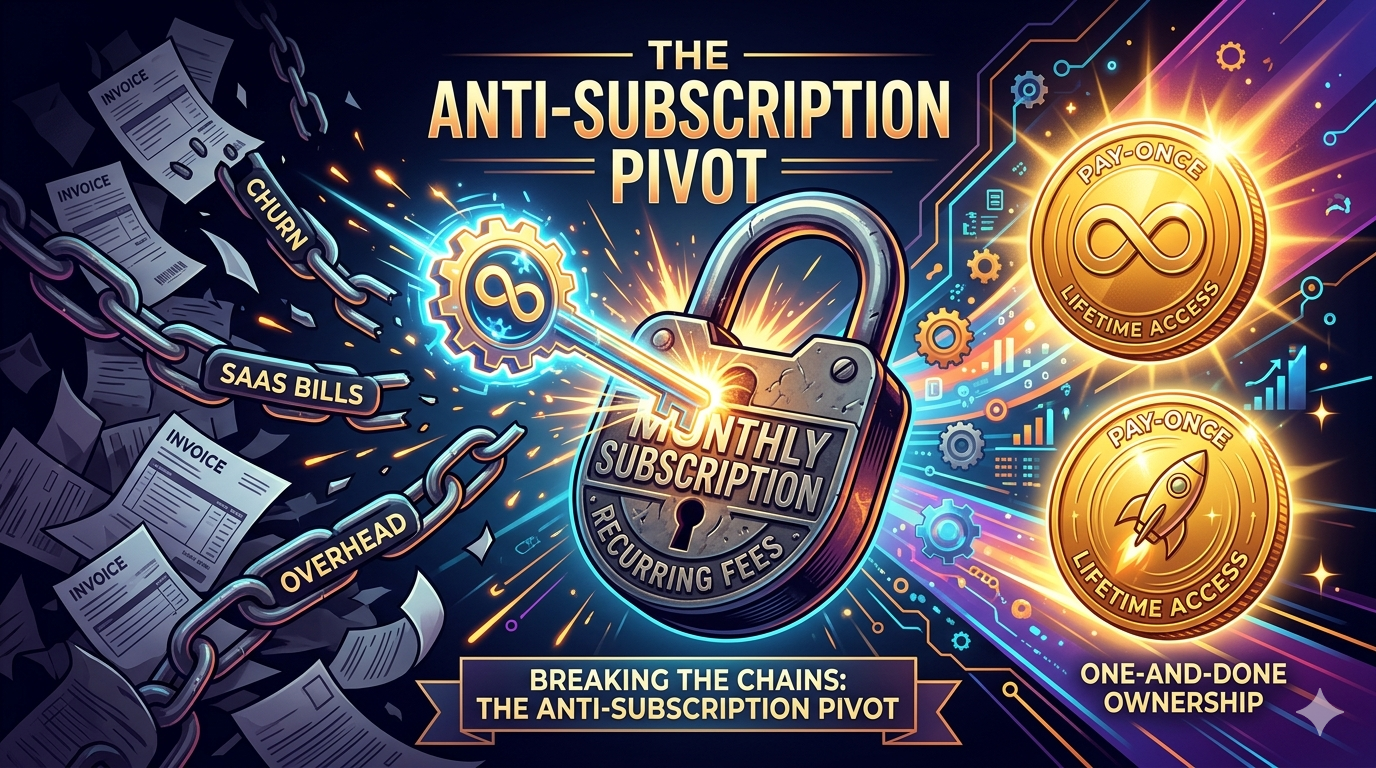
I can speak from personal experience here.. Lately, it seems that almost EVERY service costs monthly – to the point where adding another service is just getting to be too much.
The Great Subscription Exhaustion
The “Invisible” Bill
Just imagine waking up on the first day of the month, and your phone is flooded with notifications from your bank. All the monthly payments you subscribe to are due.. Most people couldn’t even tell you every single monthly subscription payment they actually make.
This is becoming a problem. The vast majority of companies have pivoted to monthly cost – in fact it’s basically the standard nowadays!
I feel like we’ve honestly reached subscription exhaustion. What started as just a way for developers to create stable revenue has turned into,.. almost a digital tax on a ‘useful’ existence. We’re no longer just ‘buying’ a software or service.. we’re RENTING it. And we’re tired of the rent going up, forever!
A True Narrative Shift Is Coming
Here’s the problem: that use to be the solution. Companies now have basically ALL optimized for MRR (monthly recurring revenue) just so absolutely aggressively, that they’ve forgotten about their average users well being.
But I guess this makes sense. The great douche Clause Schuab (probably butchered spelling, oh well) has been quoted saying ‘You’ll own nothing and be happy’, or something along those lines.
Friction in the monthly model: Each and every new subscription adds a new ‘open mental loop’ for every user.. At BEST it’s a recurring decision that one has to justify every month. At it’s WORST it’s forgotten about and just endlessly bleeds cash, without even being used.
Here’s the opportunity though: When everyone else is asking for MARRIAGE, you can be just asking for a first date! Cheesy analogy, but it gets the point home. By offering a one time payment, you can remove the long term anxiety of the purchase. You provide ownership, something that’s more and more rare in an age of ‘temporary access’.
The Math Of Offering Your Customers The “Lifetime Deal”
Many developers fear this methodology of selling because they worry about sustainability, and rightfully so. But for a micro-SaaS, or just digital products in general, that have low overhead, the math often favors the one time deal.. especially in the early stages.
Reality Check – Churn Rate
Take this scenario into consideration for a moment..
- The churn rate for small SaaS tools is fairly high on average, so if you get a customer at $15 monthly for 5 months, that give you a total contract value of $75 on average per customer.
- You offer the same tool at a one time cost of $149
In this specific scenario the one time deal customer is worth double the monthly paying – on average. Not only this, but from what I’ve noticed, single payments on a tool have a higher conversion rate than monthly. Now i’m sure there’s exceptions to this rule of course, but we’re speaking generally here.
This scenario isn’t always possible, I know. In certain fields, you’re competing with people that are already charging a single fee, AND have it at a cheap price. There’s ways to make this situation work as well.
Front Loaded Growth
Instead of waiting a year to see profit from a single user, you capture the full value on day ONE. This upfront capital lets you have a unique advantage over your monthly-charging peers:
- You can scale your ad spend faster – compete with about anyone.
- Pay for development costs much easier with more overhead.
- You can focus on building features instead of ‘retention hacks’ just to stop people from cancelling their monthly payments they’re making to you.
Tools For The Transition To A Single Payment System
To manage these one time payments without any extra headache you can use platforms that were specifically designed just for this, such as –
Lemon Squeezy these guys have easy license & key management
Gumroad can be used for a simple, high-converting checkout experience for pretty much all digital assets.
AppSumo is another choice, if you want to tap into a massive pre-existing audience of “Life-Time Deal” hunters.
Engineering Trust
Most commonly the biggest hurdle for someone buying a ‘lifetime deal’ on a product, is fear of abandonment. They’re betting essentially, that you’ll still be around whenever they need, keeping the servers up and running. You have to prove you aren’t just another scammer trying to steal a quick buck from people.
Here’s a couple ideas, all to convey that needed trust:
- Proof Of Life Roadmap – You can use tools like Canny
or Tally to host a public product roadmap. If users see that yo’re shipping updates every Tuesday they’re going to stop worrying about the tool dying. - Radical Transparency Strategy – Being extremely open about your overhead can help as well. If you’re a solo founder running a product service with only $100 a month in server costs, tell people that! It not only builds a human to human connection, but it builds a sense of well-being and trust that things can’t turn bad very easily
- Escape Hatch Promise – Heres a way to gain ultimate trust.. by promising that if the service ever shuts down, you’ll release a local version or open source version of the code so their data isn’t lost or trapped.
The Hybrid Strategy
Eventually every ‘pay once’ type product or service reaches a point where it needs consistent cash to scale. Now if you’re able to consistently drive free or paid traffic to your offer, then this won’t be as much of an issue (everyone should attempt to do this!).
The neat thing is, it’s your product.. so you can do whatever you want! Here’s how you could eventually transition from one-time to monthly without betraying your early adopters!
Legacy Clause – This is kinda like the ‘golden rule’.. If someone bought your ‘lifetime deal’ then they get to keep that deal, no matter what! Believe me, these people will become your most vocal advocates because they got in early.
The Versions 2.0 Pivot – Much like the average software in the 90s, you can keep the core tool and your one time deal, but introduce a subscription model for the cloud features, or new additions.. think AI credits, real time collaboration, high storage usage etc.
Support + Maintenance Tier – Offer the software for free, or a flat fee, but charge a small annual fee for priority support and major versions updates.
The Pro Subscription – In this method, you’d use your one time fee users to build a massive base of great reviews and social proof. Then close the ‘pay once’ deal window, and switch to a standard monthly, or yearly model.
The EVERYTHING Option – Here’s a thought for ya, give every customer all possible ways to pay. Have a monthly, yearly AND a lifetime option for them. In this specific case, you’re usually able to charge MUCH MUCH higher for the lifetime fee. This gives your user the ultimate flexibility to choose whatever they prefer.
Here’s a quick summary table laying out the two options, and their associated benefits and drawbacks:
| Feature | Pay-Once (LTD) | Subscription (SaaS) |
| Cash Flow | High up-front (Front-loaded) | Slow and steady (MRR) |
| Marketing | Much easier to sell (High urgency) | Harder to sell (Low commitment) |
| Customer LTV | Fixed at point of sale | Infinite (if they never churn) |
| Support Load | Decreases over time | Constant |
Either methodology that you choose has it’s pros and cons, so I guess it’s just about choosing which works best for you.. But in this day and age, it’s getting less and less common to see one-time payment for software / products, and WAY more common for monthly fees.
Be different! With the right free and paid traffic methods, you can turn your one time payment digital product into something that produces consistent sales month after month. It just takes some planning and a little bit of that ‘elbow grease’ your grandpappy told you about when you were a lil guy.