Category: Uncategorized

  • Validate Your Micro-SaaS Idea Using Your Blog: Finding Product-Market Fit

    Validate Your Micro-SaaS Idea Using Your Blog: Finding Product-Market Fit

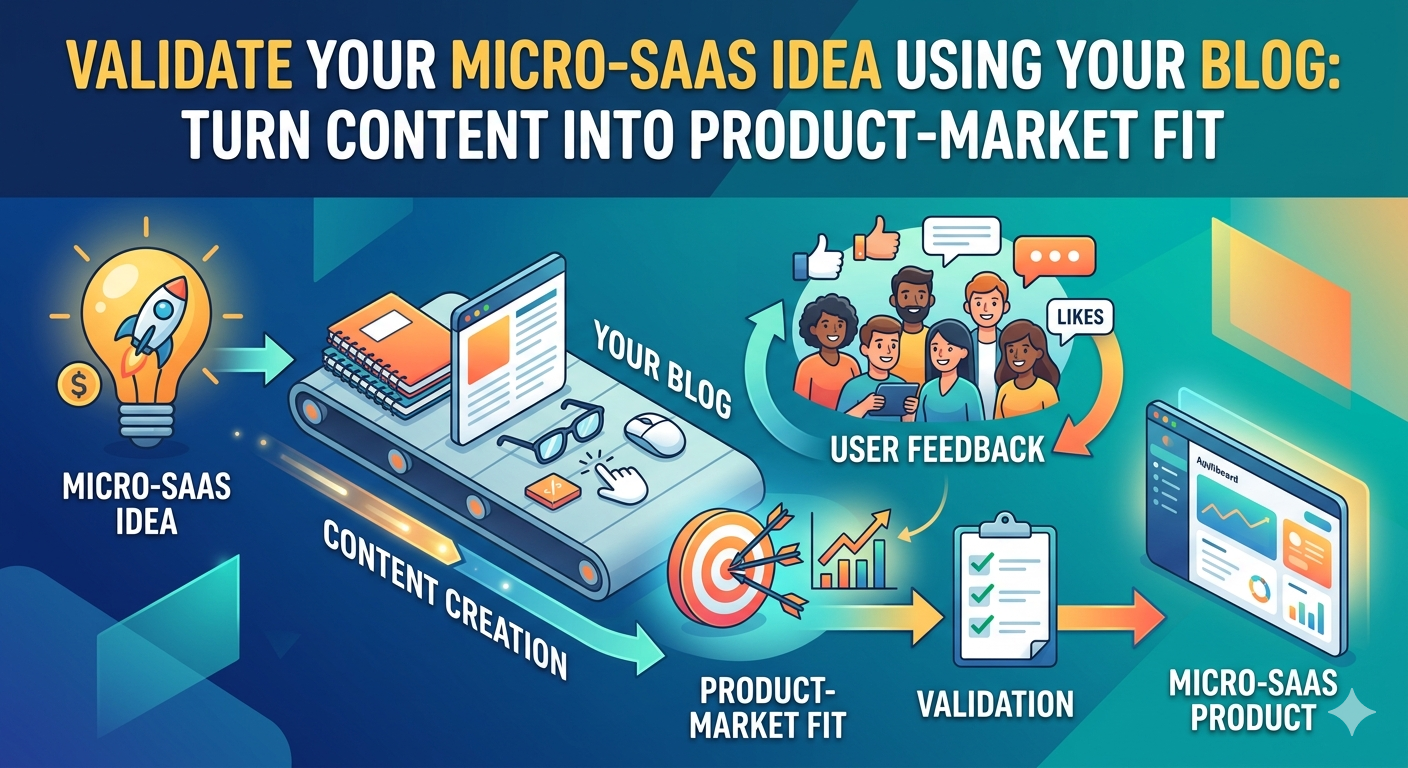
    OK so think about this..Let’s say you’ve got a blog that’s actually getting some amount of traction. People are reading your posts, leaving comments, maybe even signing up for your email list. But what if your audience isn’t just for about numbers? What if it’s your secret weapon for building a micro-SaaS that actually sells?

    Most creators approach micro-SaaS all wrong. They lock themselves in a room for 3 months, build what they think is the perfect tool, then launch to crickets. Meanwhile, they’ve been ignoring the most powerful validation tool they already own: their blog / online audience.

    The Content-First Validation Method

    Let me explain how this works for ya.. Your blog isn’t just a content channel, it’s a built-in focus group / feedback loop / early adopter network all rolled into one. Every post you write is actually a low-cost experiment in what resonates with your audience.

    When you notice certain topics consistently getting more engagement, comments, or shares, that’s not just algorithmic luck. That’s your audience telling you what problems they actually care about solving. In the world of micro-SaaS, solving real problems is literally the only thing that matters.

    Mining Your Content for Gold

    Here’s how to turn your existing blog into a idea-validation machine:

    First, go back through your top 10 performing posts (by time on page, comments, or social shares). Look for patterns in the questions people are asking in the comments. Are they repeatedly asking for tools, templates, or checklists related to a specific topic?

    Second, pay attention to which posts generate the most email signups when you offer a related lead magnet. If your post about “systemizing your client onboarding” gets 5x more newsletter subs than your post about “trendy marketing tactics,” that’s a huge signal.

    Third, notice which topics you keep returning to in your own writing. If you find yourself referencing the same framework or process over and over, that’s probably because it’s genuinely useful — not just to you, but to your readers who keep engaging with those posts.

    Let me give you a real world example: lets say you run a blog about uhhh.. coffee shop management. You notice your posts about inventory tracking and waste reduction or whatever, consistently get the most engagement from viewers. Comments keep asking: “Is there a simple tool for tracking daily bean usage?” or “How do you actually calculate waste percentage without it being a huge pain?”

    That’s not just engagement my guy, that’s a product opportunity screaming for attention! Your audience has literally told you they want a tool to solve this specific, painful problem. All you have to do is build the simplest possible version and offer it to them.

    From Blog Post to Micro-SaaS: Here’s My Process

    Here’s how to actually do this without over-complicating it. FIRST let’s find the idea.. Here’s how I’d do it:

    • Start with your highest-engagement content — the post that consistently gets the most comments, shares, or time on page
    • Alternatively simply audit your top 5 posts by engagement and note the recurring questions or pain points in comments
    • Extract the core problem — what specific task or frustration are people repeatedly mentioning?
    • Create a simple survey asking your email list which of 3 potential tools they’d pay for and why
    • Write a follow-up post proposing your micro-SaaS idea and measure the response (comments, shares, email clicks)

    Steps To Validate Your Idea

    After finding your idea, here’s exactly how I would start validating it using your blog:

    • Build the absolute minimum viable version — could be a simple Airtable base, a Google Sheets template with some formulas, or a basic Softr tool
    • Offer it to your blog audience first — make them feel like insiders getting early access
    • Charge from day one — even if it’s just $5-$20 to start, this validates that people will actually pay
    • Use their feedback to improve — every suggestion from your early users becomes your product roadmap. Iterate based on real usage.. not what you think they want, but what they actually use

    The Real Advantage: Trust Already Built

    Here’s the kicker that most people miss about using this methodology… when you launch a micro-SaaS to your blog audience, you’re not starting from zero. You’ve already spent months or years building credibility through your content. They know your voice, they’ve seen your expertise, and they’ve hopefully gotten value from your content already. So it’s a natural evolution to go from viewer to customer!

    That trust is worth more than any amount of paid advertising. It means your early adopters aren’t just buying a tool, they’re buying from someone they already believe in. And in the early days of a micro-SaaS, having users who will give you honest feedback and tell others about your tool is worth its weight in gold.

    Stop Guessing, Start Listening

    The beautiful thing about this approach is that it turns validation from a scary, uncertain process into something almost effortless. You’re not guessing what people want — you’re listening to what they’ve already told you through their engagement with your content.

    Your blog audience isn’t just some obscure number. They’re your built-in focus group, your beta tester network, and your first paying customers.. all in one convenient package. Stop treating your blog as just a content channel and start seeing it for what it really is… the most powerful validation tool you’ll ever own for your micro-SaaS ideas!

    So next time you’re wondering whether that tool idea you’ve been toying with is worth building, don’t lock yourself away to perfect it in isolation. Look at your blog analytics, read those comments, and let your audience tell you the answer.

    I hope this helped, seeya!
  • Building Human-Vetted Niche Directories with No-Code

    Building Human-Vetted Niche Directories with No-Code

    So, let’s say you’re trying to find a.. reliable mold specialist in your area. You open Google, scroll through pages of Yelp reviews that all sound suspiciously similar, and wonder which ones are actually written by real humans who’ve had real experiences…

    This is becoming an actual REAL problem.

    These days where AI-generated fake reviews are flooding every directory and review site, trust is officially broken. People are desperate for sources they can actually believe in…especially when it comes to important decisions about their homes, health, businesses & wealth.

    Here’s my thought.. human-vetted niche directories aren’t just a convenient concept anymore.. they’re becoming the biggest passive income opportunity of 2026. And the best part is that you don’t need to know how to code to build one anymore!

    The Trust Crisis in Online Directories

    Let’s talk about why traditional directories like Yelp, Angie’s List, and even Google Maps are losing credibility fast..

    It’s not just about a few fake reviews here and there.. we’re talking about full systematic, AI-generated content designed to manipulate rankings and trick consumers.

    These fake reviews aren’t just annoying.. they’re actually dangerous.. When someone’s choosing a contractor for electrical work or a longevity clinic for hormone therapy, fake positive reviews can lead to real harm.

    The verification systems these big platforms use are outdated, easily gamed, and completely overwhelmed by the scale of AI content flooding in.

    What we’re seeing is a complete reversal of what made directories valuable in the first place. Instead of being trusted hubs of local knowledge, they’ve become marketplaces where the loudest (or most AI-optimized) voice wins.. not the most honest or experienced reviews.

    The Human-Vetted Alternative: Trust Hubs

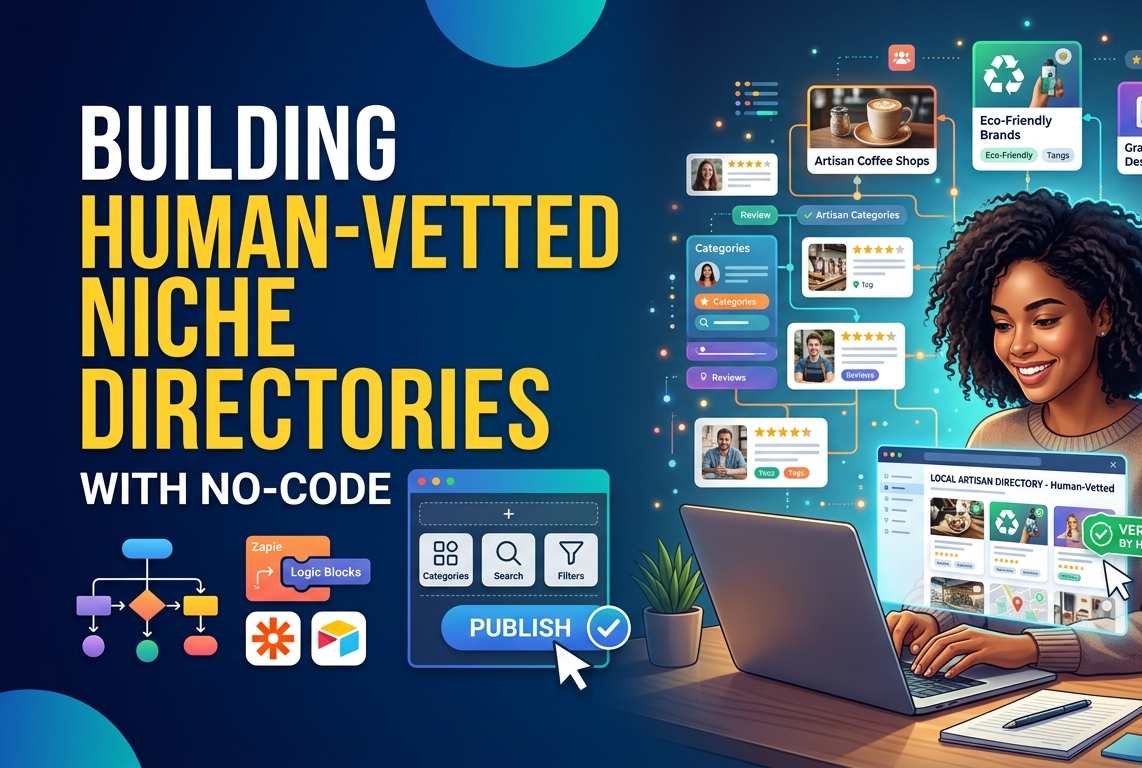
    Enter the human-vetted niche directory, what I like to call a “trust hub.” This isn’t just another directory with a fancy verification badge.. No no! It’s a carefully curated ecosystem where every single listing has been manually verified by a real human who understands the industry / niche and can provide actual valuable insight into which companies may work best for them.

    Think of it like this.. instead of trusting an algorithm to spot fake reviews, you’re trusting a person who actually knows what legitimate work looks like in that specific niche. They’re checking licenses, making shadow calls, verifying insurance, and looking for those subtle tells that separate the pros from the pretenders.

    And because you’re focusing on a specific niche.. let’s say, sustainable home retrofitting.. AI compliance consulting, you can go deep. You’re not trying to be everything to everyone, you’re becoming the definitive authority in one specific area where trust is one of, if not the most important thing!

    Why No-Code Tools Are Perfect for This

    Now, you might be thinking: “This sounds great, but building and maintaining a directory with manual verification sounds like a ton of work.” And you would be right.. if you were trying to code everything from scratch.

    But here’s where modern no-code tools change the game completely. With platforms like Softr, Airtable, and Make.com, you can build a sophisticated directory with automated workflows that handle 80% of the grunt work, leaving you free to focus on the high-value human verification tasks.

    Let me break down how this actually works in practice:

    Airtable becomes your backbone—it’s where you store all your business listings, verification notes, license documents, and communication history. You can set up different views for pending verification, approved listings, and expired certifications.

    Softr turns that Airtable base into a beautiful, searchable directory website with zero coding. Members can search by location, specialty, or certification level, and you get built-in user accounts, payment processing, and SEO optimization.

    Make.com (formerly Integromat) handles the automation magic—it can automatically check license expiration dates, send renewal reminders to businesses, trigger verification workflows when new listings come in, and even pull in public data from government databases to pre-fill application forms.

    The Verification Workflow That Actually Scales

    This is where most people get stuck—they imagine having to manually verify every single aspect of every business, which obviously doesn’t scale. But the trick is to create a tiered verification system that focuses human effort where it matters most.

    Here’s how I would personally structure this:

    First, automate everything you can. Use Make.com to check if a business license exists in state databases, verify basic insurance coverage through public records, and scrape websites for service area and contact information.

    Second, create a verification checklist that your human verifiers actually use. This isn’t just “does this business exist?”—it’s specific, actionable items like:

    • Does their license match the services they advertise?
    • Have there been any complaints filed with the state licensing board?
    • Do they carry the specific types of insurance needed for this type of work?
    • Can we verify at least two recent customer references through direct contact?

    Third, batch your verification work. Instead of verifying one listing at a time, set aside specific verification blocks where you process 10-15 applications in a row. This builds efficiency and helps you spot patterns or red flags that might be missed when verifying sporadically.

    Making It Profitable: The Trust Premium

    Now let’s talk potential cash flow.. because if this isn’t profitable, it’s just a hobby. The beauty of human-vetted directories is that you can charge premium prices precisely because you’re offering something the AI-powered giants can’t: genuine trust.

    For niches like emergency home infrastructure (plumbing, electrical, HVAC), longevity/wellness clinics, or AI compliance consulting, businesses are often paying $50-200 per qualified lead. When you can demonstrate that your leads come with a human-verified trust badge, conversion rates go through the roof.

    I’d recommend starting with a free basic listing to build initial traction, then offering tiered paid options:

    • Free: Basic NAP (name, address, phone) with limited visibility
    • Verified ($49/month): Includes human verification badge, priority placement, and lead notifications
    • Premium Verified ($99/month): All verified features plus featured placement, analytics, and direct booking options

    The key insight here is that you’re not just selling directory placement, you’re selling risk reduction! For businesses in high-trust niches, that verification badge means they stand out in a sea of unverified competitors and can justify higher prices themselves.

    Getting Started: Your First 30 Days

    Okay, let’s get practical. If you’re excited about this opportunity, here’s exactly how I’d approach building your first human-vetted niche directory in the first month:

    • Week 1: Pick your niche and research the verification requirements. What licenses matter? What are the common pain points customers have finding trustworthy providers? Join 2-3 Facebook groups or forums in your niche to listen to real conversations.
    • Week 2: Set up your Airtable base with fields for business info, verification status, license numbers, insurance details, and notes. Build your Softr site using a directory template—focus on clean search and mobile responsiveness first.
    • Week 3: Create your verification workflow in Make.com. Start simple: automate license checks and expiration reminders. Design your verification checklist based on what you learned in week 1.
    • Week 4: Onboard your first 10-15 businesses manually. This part is crucial, you want to refine your verification process with real applications before worrying about scale. Ask for feedback on both the application process and the value they’re seeing from being listed.

    Have you thought about making your own human-vetted niche directory? If so let me know how it’s going, or if you have any questions below! Take care – Josh

  • Human-Vetted Directories in the AI Era – Combine Trust & Automation

    Human-Vetted Directories in the AI Era – Combine Trust & Automation

    Ok so… imagine running a niche directory where every listing feels like a personal recommendation from a trusted friend.. That’s the magic of human-vetted trust hubs — they turn casual browsers into loyal customers because the vetting process itself builds credibility.

    But here’s the thing.. as AI floods the web with auto-generated listings and fake reviews, maintaining that human touch feels harder than ever. You might worry that scaling your directory means sacrificing the very trust that makes it valuable.

    What if you could use AI to handle the grunt work while keeping humans in the loop for final approval?

    The Trust vs Scale Dilemma

    Most directory owners hit a ceiling when they try to grow beyond a hundred listings.. Manual verification eats up time, and hiring a team quickly erodes profits.. Meanwhile, AI-powered aggregation tools can scrape thousands of data points in minutes, but they lack judgment — they can’t tell if a business is legit or just a clever facade.

    This tension isn’t new, but AI makes it sharper.. On one side, you have the authenticity that only human vetting provides; on the other, the scalability that automation promises.. The solution isn’t choosing one over the other — it’s designing a workflow where each does what it does best.

    Let me explain.. Think about a local plumbing directory — you could spend hours calling each business to verify licenses and insurance, or you could let AI pull data from state contractor boards and online reviews in seconds.. But only a human can tell if that “licensed” plumber actually shows up on time and fixes leaks properly.

    I’ve seen this play out in concrete terms: a directory owner I know spent three months manually verifying 120 listings for a home renovation niche.. By month four, burnout hit, and verification quality dropped.. Then they brought in an AI-assisted workflow and doubled their output while actually improving accuracy — because humans focused on judgment calls, not data gathering.

    AI as the Data Scout

    Think of AI as your tireless intern who loves digging through public records, social media, and review sites.. It can pull business names, addresses, phone numbers, and even sentiment analysis from existing reviews at scale.. For example, you could use AI to:

    • Aggregate basic info from Google Maps, Yelp, and industry-specific sources
    • Flag potential duplicates or inconsistent NAP (name, address, phone) data
    • Detect obvious red flags like missing websites, generic templates, or sudden spikes in negative sentiment

    The key is treating AI output as raw material, not finished product.. You still need a human to interpret context — like knowing that a “missing website” might be fine for a decades-old plumbing shop that relies on word-of-mouth.

    I’ve seen this work beautifully in HVAC directories where AI gathers service areas and certifications, but humans verify that technicians actually have the right equipment for commercial vs residential jobs.

    I’ll give you a concrete example: imagine you’re building a directory for licensed electricians in older neighborhoods.. AI can quickly pull license numbers from the state database, check for any disciplinary actions, and gather online reviews.. But a human verifier might notice that while the license is current, the business has changed ownership twice in the last year — something that could affect consistency of service.. Or they might see that the address listed is actually a residential home, raising questions about whether it’s a legitimate commercial operation.

    The Human Verification Gate

    Now picture a simple but powerful checkpoint: after AI gathers and pre-processes a listing, a real person reviews it before it goes live.. This doesn’t have to be slow if you design it right.. Use a lightweight internal tool (think Airtable or Softr) where reviewers see:

    • The AI-collected data highlighted for quick scanning
    • Any discrepancies or warnings the system flagged
    • Links to original sources for spot-checking

    A trained verifier can make a call in under two minutes per listing.. More importantly, they can apply nuance — like recognizing that a business with a sparse online presence might still be highly reputable in its local community.

    Here’s the thing about human judgment: it catches the subtle stuff AI misses.. Like when a business has perfect online ratings but multiple verifiers mention rude technicians — or vice versa, where a grizzled contractor with a barebones website has decades of proven results.

    I remember working on a directory for historic home restoration contractors.. The AI kept flagging businesses with low Google review counts as risky.. But our human reviewers kept approving them because they knew these specialists get most of their work through referrals from architects and preservation societies — not online searches.. If we’d relied solely on AI, we’d have missed some of the best craftsmen in the field.

    Closing the Loop with Feedback

    Here’s where the flywheel starts spinning: every human decision feeds back into the AI, making it smarter over time.. If reviewers consistently reject certain types of listings, you can adjust the AI’s scoring model to pre-filter those out.. Conversely, if the AI keeps missing legit businesses that humans approve, you expand its data sources or tweak its parameters.

    This creates a virtuous cycle where automation handles volume, humans ensure quality, and the system gets better at predicting what’ll pass inspection.. Over time, you’ll spend less time on each listing and more on growing your directory’s reach and revenue streams.

    I like to think of it as teaching the AI through examples — each “approved” or “rejected” stamp becomes a data point that refines its understanding of what quality looks like in your specific niche.

    For instance, after a few months of human verification, you might discover that your AI is overly cautious about businesses that operate primarily through Facebook pages rather than traditional websites.. You can then adjust the algorithm to weigh social media presence more heavily, reducing false positives.. Or you might find that certain address formats in rural areas are consistently flagged as incorrect when they’re actually perfectly valid — another pattern to teach the AI.

    I’ve watched this feedback loop transform a directory’s efficiency: early on, humans reviewed 80% of AI-suggested listings; after six months of tuning, that dropped to 30%, freeing up verifiers to focus on edge cases and new niches.

    Actionable Steps to Build Your Hybrid Directory

    • Start with a clear niche and define your verification criteria (license checks, social proof, etc.)
    • Choose an AI tool or script for initial data gathering (Python with Selenium, Apify, or even no-code scrapers)
    • Set up a simple review interface where humans can approve, reject, or request more info
    • Log every decision and use it to refine your AI’s accuracy weekly
    • Publish only after human sign-off, and display a “Verified by Humans” badge to reinforce trust

    Pro tip: Begin with a micro-niche — like “licensed electricians in historic districts” or “organic coffee roasters with direct trade relationships” — to prove your model before expanding.

    I’ve seen folks try to boil the ocean and get overwhelmed.. Trust me, it’s way better to start small, prove your workflow, and then scale.. You’ll learn what your human verifiers actually need to see, what the AI struggles with, and how to tune the feedback loop.. Once you’ve got that down, expanding to related niches becomes much smoother.

    I’ll share a quick story: a friend launched a directory for sustainable building materials.. They began with just reclaimed wood suppliers in their metro area.. After nailing the verification process there, they added solar installers, then eco-friendly paints, and now they’re approaching a full green building directory — all because they validated the model first.

    Bigger Picture: Trust Is Your Moat

    In a world where anyone can spin up a directory with AI-generated content, your commitment to real human oversight becomes your competitive advantage.. It’s not just about preventing spam — it’s about signaling to users that you care enough to put eyes on every listing.. That signal builds loyalty, reduces churn, and opens doors to premium monetization like lead sales or featured placements.

    Think about it — when was the last time you trusted a list of “top 10 dentists” that was clearly auto-generated? Now imagine seeing a badge that says “Each dentist verified by a human for license status and patient reviews.” Suddenly, that directory feels worth paying attention to.

    I’ll let you in on a little secret: the most successful directory owners I know don’t compete on quantity — they compete on quality and trust.. They know that in niches like emergency home services, longevity wellness, or AI compliance, users are willing to pay a premium or go out of their way to find a source they can truly believe in..

    And here’s the kicker — this human-first approach actually makes your directory more resistant to AI disruption.. As AI-generated content floods the internet, your verified human stamp becomes a beacon of reliability that algorithms can’t fake.. You’re not just building a directory; you’re building trust infrastructure.

    So embrace the bots for the busywork, but keep the final say where it belongs: with people who understand that trust isn’t a feature — it’s the foundation..

    i’m excited to see what you build with this approach — go make something real!

    Take care guys! 🙂

  • How to Validate Your Micro-SaaS Idea in 48 Hours or Less

    How to Validate Your Micro-SaaS Idea in 48 Hours or Less

    You’ve got a brilliant micro-SaaS idea that keeps you up at night.. But what if you build it and nobody cares? That’s the nightmare that stops most founders before they even start typing the first line of code.

    What if you could know in 48 hours whether your idea is worth pursuing?

    Most founders waste months building products nobody wants because they skip validation. They fall in love with their solution before proving there’s a problem worth solving. The result? Ghost towns of abandoned side projects and drained bank accounts.

    I’ve been there too many times to count. That sinking feeling when you launch to crickets? Yeah, it sucks. But here’s the good news.. you can avoid this pain with a simple 48-hour validation sprint that costs less than a fancy dinner out.

    Think of validation as your idea’s immune system — it fights off the bad infections before they spread. When you validate early, you’re not being pessimistic; you’re being smart about where you spend your precious time.

    The 48-Hour Validation Sprint: Speed Kills Indecision

    Forget lengthy market research reports and endless surveys. Validation isn’t about perfection.. it’s about speed and signal. In two days, you can run enough experiments to get a clear yes/no on whether to build, pivot, or abandon.

    Think of it like a medical triage for your idea… quick tests that reveal if there’s life worth saving. The goal isn’t to validate every assumption — just the riskiest one: will people actually pay for this?

    When i ran my first validation sprint for a micro-SaaS idea last year, i was shocked at how clear the signals were. By hour 36, i had enough data to make a confident decision. No more guessing, no more “maybe if i just add one more feature…”

    The beauty of this approach is that it forces you to confront reality early. Either you get validation that fuels your motivation, or you get a clear signal to pivot or abandon — both outcomes are wins because they save you time.

    I like to think of validation as the ultimate test for founder optimism bias. We’re all guilty of seeing our ideas through rose-colored glasses; validation strips those glasses off and shows us the real colors of the market.

    Customer Interviews That Don’t Suck

    Talk to 5-7 people who match your target customer profile — not friends or family who will lie to spare your feelings. Use the “problem interview” format: ask about their current workflow, pain points, and what they’ve tried to fix it. Listen more than you pitch.

    Here’s the script that works...

    “Walk me through the last time you dealt with [problem]. What did you do? What sucked about that process? If you could wave a magic wand, what would change?” Take notes, look for emotional language and willingness to pay or switch.

    For a micro-SaaS targeting HVAC contractors (as i talked about in my article on The Local Service Micro-SaaS), you’d ask about their scheduling headaches, invoicing pains, or how they track jobs. Listen for those “ugh” moments — that’s your opening.

    Pro tip: record these interviews (with permission) so you can focus on listening instead of frantic note-taking. You’ll catch nuances you’d miss otherwise, like tone of voice or hesitation that signals real pain.

    Another trick I’ve learned.. : Start each interview by saying you’re not selling anything — you’re just trying to understand their world. This lowers defenses and gets you honest answers about what really bugs them day to day.

    I’ve found that the best insights often come from the “what else?” question after you think the interview is over. Keep the recorder running and ask, “Is there anything else about this problem that we haven’t covered?” That’s when the gold often shows up.

    Landing Page Test: Fake It Till You Make It (Ethically.. Of Course!)

    Build a one-page website that explains your solution, shows pricing, and has a clear call-to-action — usually “Join Waitlist” or “Get Early Access.” You don’t need the product yet; you’re testing whether the promise alone gets people to leave their email.

    Use Carrd.co or Leadpages (or even a simple WordPress page) to get something up in an hour. Drive cheap traffic via Reddit ads, Facebook groups, or LinkedIn sponsored content targeting your niche.

    Spend $20-50 to get 100-200 visitors.

    If you get 10%+ email conversion, you’ve got strong interest. Below 3%? Either your messaging is off or the problem isn’t painful enough. Iterate on the headline and value proposition before deciding.

    I’ve seen landing pages convert at 25%+ for well-targeted micro-SaaS ideas in boring niches. The key is specificity — speak directly to one person’s problem, not a vague audience. Your headline should make the ideal customer think “how did they know i was thinking that?!”

    Don’t over-complicate the page here.. a clear headline, a short paragraph explaining the solution, bullet points of benefits, pricing info, and the email form. That’s it. Everything else is distraction.

    Remember to set up proper tracking so you know where your visitors are coming from. UTM parameters are your friend here — they’ll tell you which ad or post is actually driving interest.

    Pre-Sales: The Ultimate Validation To Your Idea

    Ask interviewees who lit up during the problem conversation: “If i built this exactly as we discussed, would you buy it today?” If they say yes, hit them with: “Great — can you send $50 to hold your spot for the beta?”

    This isn’t about scamming people; it’s about filtering polite interest from real commitment. If they balk at putting skin in the game, dig deeper: is it price, timing, or genuine lack of need? Getting even 2-3 pre-sales validates that someone will actually exchange money for your solution.

    When i tested this approach with a developer tool idea, i got three pre-sales at $100 each — that covered my domain and hosting costs for the MVP. Those early customers also became my best advocates, giving feedback that shaped the product in ways i never would have guessed.

    Remember: money talks, everything else walks. If people won’t put up even a small amount to validate their interest, you probably don’t have a business — you have a interesting hobby.

    One nuance: make it clear that the pre-sale is for a future product and that you’ll deliver or refund if things don’t work out. This builds trust and sets proper expectations. Most people appreciate honesty more than false promises.

    How to Interpret Results: Build, Pivot, or Abandon:

    After 48 hours, look at your signals:

    • Interview consistency: did multiple people describe the same painful problem?
    • Landing page conversion: are people excited enough to leave contact info?
    • Pre-sales: did anyone actually pull out their wallet?

    If you have strong signals across at least two areas, move to building a minimal version. If signals are weak or contradictory, pivot the idea based on what you learned — maybe it’s a different customer segment or a narrower feature set. If there’s near-zero interest, abandon it happily. You just saved yourself months of misery. Or at VERY least, reconsider your angle / problem that you’re solving.

    Try Using This Simple Scoring System..

    I like to use a simple scoring system: give each signal area 0-2 points (0=none, 1=weak, 2=strong). If you score 4+ points out of 6, you’ve got enough validation to proceed. 2-3 points means pivot time. 0-1 points means abort mission and celebrate the time you saved.

    The key insight here is that validation isn’t about proving your idea is perfect — it’s about killing bad ideas fast so you can spend time on the ones that have real legs. Your time is your most limited resource; treat it like the precious asset it is.

    I’ve seen founders ignore weak validation signals and build anyway, only to learn the hard way that hope is not a strategy. Trust the process, even when it tells you to walk away from something you love.

    Tools That Make Validation Easier

    You don’t need fancy equipment to run a validation sprint — just a few smart tools that save you time and headaches.

    For interviews: Calendly for scheduling, Zoom or Google Meet for calls, Otter.ai for transcription (free tier works fine). A simple Google Doc or Notion page for notes is plenty.

    For landing pages: Carrd.co is stupid simple and cheap ($19/year for pro). If you want more flexibility, try Leadpages or Unbounce — both have free trials. Or spin up a quick WordPress site with a theme like Astra.

    For traffic: Facebook Ads Manager lets you target incredibly specific niches (like “people who manage HVAC businesses in Texas”). Reddit ads work well for tech/startup audiences. LinkedIn is gold for B2B micro-SaaS ideas.

    For pre-sales: Stripe or PayPal links work fine. Or use Gumroad if you want something that handles delivery later. The key is making it stupid easy for people to give you money.

    I keep a validation toolkit bookmarked in my browser — a folder with links to all these services so i can spin up a test in minutes rather than hours. Preparation makes execution painless.

    • Day 1 Morning: Run 5 problem interviews using the script above; look for patterns in pain points.
    • Day 1 Afternoon: Build a simple landing page with clear value proposition and pricing; set up analytics.
    • Day 1 Evening: Drive $20-50 of targeted traffic to the page; monitor sign-up rate.
    • Day 2 Morning: Follow up with interview participants who showed high interest; attempt to collect pre-sales.
    • Day 2 Afternoon: Review all data; decide to build, pivot, or abandon based on the framework above.
    • Day 2 Evening: Document your findings and next steps — even if you abandon, note what you learned for future ideas.

    Validation isn’t ‘cool’, but it’s the secret sauce that separates profitable micro-SaaS ventures from expensive hobbies. By forcing yourself to test before you build, you stack the odds in your favor.. and that’s how you build a stack of tiny profitable tools instead of one big complex app (hey, that sounds familiar!).

    Hope this helped you in some way, seeya!

    Also, I covered this more in depth in my article on The Micro-SaaS Profit Stack: Building Multiple Tiny Profitable Tools Instead of One Large App, where i explain why multiple small bets beat one big swing basically every time..

    Oh & also check out my post on The Creator’s AI Toolkit: Using AI Without Becoming AI Slop for how to use AI tools to accelerate each validation step without losing your human edge.

  • Stack Your Revenue: How One Niche Can Generate 5 Income Streams Without 5x The Work

    Stack Your Revenue: How One Niche Can Generate 5 Income Streams Without 5x The Work

    Ok so, here’s something that bugs me about the way most people approach online business..

    They pick ONE thing. Maybe it’s an ebook. Maybe it’s a SaaS tool. Maybe it’s a blog with some ads on it. And then they pour everything into that one channel and pray it works out.

    And look, i’m not saying that’s always wrong. Single focus is powerful. But here’s what nobody tells you..

    What if that ONE niche you already picked could be generating 5 separate income streams — without you doing 5x the work?

    Because that’s the actual unlock. It’s not about spreading yourself thin across a dozen random side hustles.

    It’s about going deeper into the niche you already understand, and letting each piece of the puzzle feed the next.

    I call this Revenue Stacking. And once you see how it works, you’ll wonder why you ever thought you needed a “second business” to diversify.

    The Single Stream Trap

    Lets say you built a nice little blog about commercial cleaning. You’re getting 10,000 monthly visitors, running some display ads, maybe pulling in $300-$500/month from AdSense or Mediavine.

    Not bad. But here’s the problem — you’re sitting on a goldmine of attention and trust, and you’re cashing it in at the lowest possible rate.

    Display ads pay you pennies per visitor. That same visitor who’s reading your article about “best commercial floor cleaners” is actively looking for solutions.

    They have their wallet out. And you’re showing them a banner ad for car insurance.

    That’s the Single Stream Trap. One monetization channel for an audience that would happily pay you in four other ways.

    As i talked about in my article on [The Creator Flywheel], the real power comes when each product leads naturally to the next. Revenue Stacking is the financial blueprint behind that concept.

    The 5 Revenue Layers (And Why They Compound)

    Here’s the framework. Every niche — and i mean every niche, even the boring ones — can support these 5 layers:

    Layer 1: Content Revenue (blog ads, affiliate links, sponsored posts)

    Layer 2: Digital Products (ebooks, templates, checklists, courses)

    Layer 3: Micro-SaaS Tool (one focused software solving ONE painful problem)

    Layer 4: Directory or Marketplace (listing fees, featured placements, lead generation)

    Layer 5: Community or Membership (monthly access to a curated group + ongoing value)

    Now here’s what makes this POWERFUL — each layer doesn’t exist in isolation. They compound.

    Your blog content drives traffic. That traffic discovers your ebook. The ebook buyer trusts you enough to try your SaaS tool.

    The SaaS tool users want to be listed in your directory. And the directory members want to join the community to network with each other.

    It’s a chain. Not 5 separate businesses. One ecosystem.

    Let’s Do The Math: A Real Example

    Ok lets make this concrete. Imagine you picked the niche of independent HVAC contractors. Boring? Absolutely. Profitable? Spectacularly.

    Here’s what your revenue stack could look like after 12-18 months of building:

    Layer 1 — The Blog

    You write 50-60 articles about HVAC business topics. Marketing tips for contractors. How to handle seasonal slowdowns.

    Best CRM tools for small HVAC shops. etc etc.

    At 15,000 monthly visitors with decent ad placement, you’re pulling in roughly $400-$800/month in display ad revenue. Plus maybe $200-$400/month in affiliate commissions from tools you recommend.

    –> Estimated: $600-$1,200/month

    Layer 2 — The Ebook Bundle

    You package your best content into a practical guide. “The HVAC Contractor’s Marketing Playbook” — 80 pages, real examples, step-by-step. Sell it for $29 on Gumroad.

    As i covered in my [24 Hour Product Sprint](https://www.joshkatherman.com/24-hour-product-sprint-launch-your-first-sellable-e-book-by-tomorrow/) post, you can literally build this in a weekend from content you’ve already written.

    At 30-50 sales per month (your blog is the funnel), that’s:

    –> Estimated: $870-$1,450/month

    Layer 3 — The Micro-SaaS Tool

    You noticed from your blog comments and emails that HVAC contractors are TERRIBLE at follow-up quotes. They give a quote, then forget to follow up, and lose the job to whoever texts back first.

    So you build a simple quote follow-up tool using no-code (Softr + Supabase + Make.com). Contractor enters a quote, the tool auto-sends follow-up texts at Day 1, Day 3, and Day 7.

    Charge $19/month.

    This is exactly the kind of Minimum Viable Solution i talked about in my [MVS Framework](https://www.joshkatherman.com/the-minimum-viable-saas-framework-how-to-build-profitability-not-complexity/) article. One problem. One tool. Done.

    At 80-120 subscribers:

    –> Estimated: $1,520-$2,280/month

    Layer 4 — The Directory

    You launch “TrustedHVAC.com” — a human-vetted directory of quality HVAC contractors. You personally verify licenses, check reviews, even do shadow calls.

    Charge contractors $49/month for a premium listing, or $29/month for basic.

    The blog drives homeowners TO the directory. The directory drives contractors BACK to your blog. Beautiful loop.

    At 40-70 paying contractors:

    –> Estimated: $1,160-$3,430/month

    Layer 5 — The Community

    You create “The HVAC Business Circle” — a private Slack or Discord group for contractors in your directory. Monthly Q&A sessions, shared leads in their area, seasonal strategy discussions. $15/month.

    At 50-100 members:

    –> Estimated: $750-$1,500/month

    Let’s add it up at the LOW end:

    — Content Revenue: $600/month

    — Digital Products: $870/month

    — Micro-SaaS: $1,520/month

    — Directory: $1,160/month

    — Community: $750/month

    Total: $4,900/month from ONE niche.

    And that’s the conservative estimate. The high end pushes past $8,800/month. From a “boring” HVAC niche. No venture capital. No team of 12.

    Just you, building deliberately and tactically. Pretty cool right?

    Why This Beats The “5 Side Hustles” Approach

    I see people all the time trying to diversify by starting completely separate businesses. They’ve got a blog over here, a dropshipping store over there, some freelance work on the side..

    Maybe a YouTube channel about something totally unrelated.

    That’s not diversification. That’s dilution.

    When you stack revenue within ONE niche, you get three massive advantages:

    1. Shared Audience

    Every customer you acquire serves ALL five layers. One marketing effort, five revenue streams. You’re not starting from zero every time you launch something new.

    2. Compounding Trust

    Each product builds credibility for the next. Someone who reads your blog AND bought your ebook AND uses your tool?

    They will absolutely pay for your directory listing. They already trust you. The sale is practically made before you even pitch it.

    This is what i was getting at with the concept of [Identity Marketing] … you’re not just selling products, you’re becoming the go-to person in that world. The niche becomes part of your identity and your customers’ identity.

    3. Lower Churn Across The Board

    Here’s one people don’t think about. When a customer is using your SaaS tool AND listed in your directory AND a member of your community.. they’re not going anywhere.

    The switching cost is massive — not because you’ve locked them in, but because the value of staying is so high.

    Compare that to a standalone SaaS with 5-8% monthly churn. When you’re woven into someone’s business across multiple touchpoints, churn drops to basically nothing.

    The Build Order (Don’t Skip This!!)

    Now, here’s where most people mess this up. They try to launch all 5 layers at once. That’s a recipe for burnout and half-finished products.

    Here’s the order i’d recommend:

    Phase 1 (Months 1-3): Content Only

    Build your blog. Write 20-30 cornerstone articles. Establish topical authority.

    Get your first 5,000 monthly visitors. No monetization yet except maybe basic affiliate links.

    This is your content base — and if you want to understand why this step is non-negotiable, check out my post on [Building Your Content Base].

    Phase 2 (Months 3-6): Add Digital Products

    Package your best content into an ebook or template bundle. This is the lowest-effort revenue layer and validates that people will actually pay you in this niche.

    Phase 3 (Months 6-9): Build The Micro-SaaS

    By now you know your audience’s pain points from blog comments, emails, and ebook buyer feedback. Build the simplest possible tool that solves their #1 frustration. No-code is your friend here.

    Phase 4 (Months 9-12): Launch The Directory

    You’ve got traffic, products, and a tool. Now create the directory that connects service providers with customers. Your existing audience is your launch base.

    Phase 5 (Months 12-18): Open The Community

    The community is LAST because it only works when you already have enough engaged users to make it valuable.

    A community with 5 people is a ghost town. A community with 80+ people who already use your products? That’s a room full of people who want to talk shop.

    Your Revenue Stack Starter Checklist

    Here’s your action plan. Pick your niche (or use the one you’ve already got) and map this out:

    • Identify your niche’s top 20 questions people search for (this becomes your content plan)
    • List the 3 biggest frustrations your audience has with existing tools or processes (this becomes your SaaS idea)
    • Find 1 existing piece of content you could expand into a $19-$39 ebook

    –> Research whether a quality directory exists in your niche (spoiler: it probably doesn’t)

    –> Talk to 5-10 people in your niche and ask what community or network they wish existed

    –> Write down your Phase 1 content calendar for the first 30 days

    –> Set a revenue target for each layer at the 12-month mark

    Don’t try to do everything at once. The whole point of stacking is that each layer builds on the last. Start with content. Let the audience tell you what they need next.

    You don’t need five businesses to build five income streams. You need one niche and the patience to build it layer by layer.

    The revenue stack isn’t a hack. It’s not a shortcut. It’s just the mathematically obvious approach once you stop thinking about “products” and start thinking about ecosystems.

    Every article you write, every tool you build, every directory listing you verify — they all feed each other. And over time, that compounding effect turns a “boring” niche into something that generates real, diversified income.

    So pick your niche. Start stacking. And stop trying to juggle five unrelated side hustles when one focused ecosystem can outperform all of them combined.

    Hope this helped you think about your niche in a new way.. take care! 🙂

  • The Local Service Micro-SaaS: How HVAC, Plumbing, and Electricians Can Profit from Tiny Software Tools

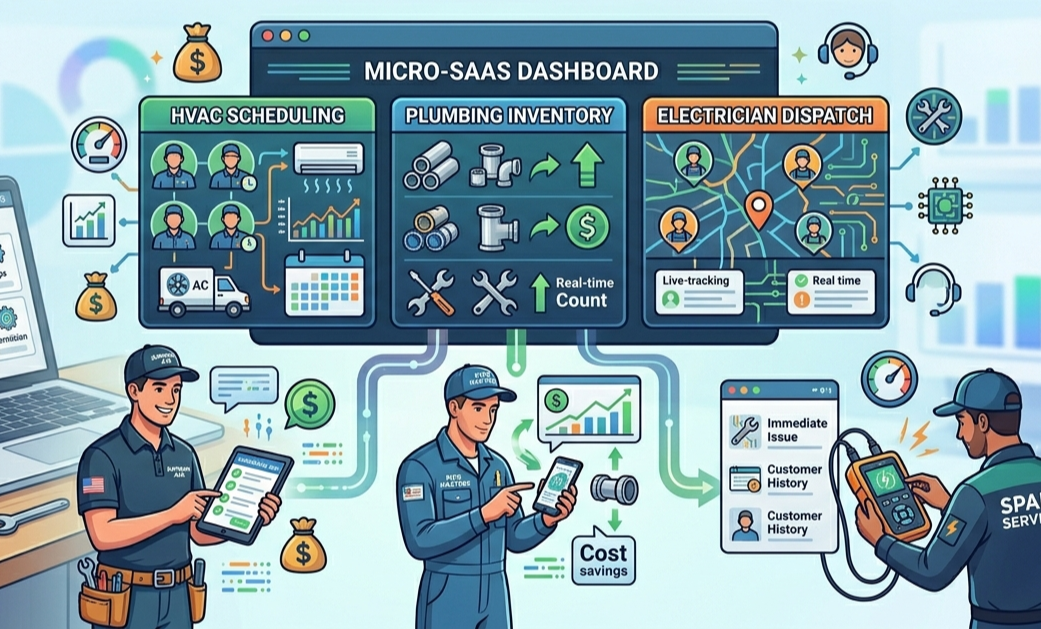
    The Local Service Micro-SaaS: How HVAC, Plumbing, and Electricians Can Profit from Tiny Software Tools

    Just for a second, imagine you’re running a small HVAC company in Ohio.. You’ve got 5 trucks, 12 employees, and you’re booked solid 3 weeks out..

    But here’s the thing — you’re still trading time for money.. Every service call requires you or one of your techs to be physically present..

    What if you could productize some of that expertise?

    What if your most valuable knowledge could work for you while you sleep?

    Let me explain.. Most local service businesses miss a huge opportunity: they think software is only for Silicon Valley startups or e-commerce brands.. They see quotes for custom software development and immediately shut down — $50K minimum, 6-month timeline, ongoing maintenance costs.. Meanwhile, their competitors in other industries are quietly building tiny software tools that automate their repetitive tasks, generate leads while they sleep, and create entirely new revenue streams..

    The problem isn’t that local service businesses can’t benefit from software..

    It’s that they’ve been sold the wrong version of it..

    They don’t need another bloated CRM or field service management suite that tries to do everything poorly..

    They need the opposite — hyper-specific tools that solve ONE painful problem incredibly well..

    The Micro-SaaS Mindset Shift

    Here’s where most local business owners get it wrong: they think they need to build the next Salesforce or ServiceTitan to compete.. The reality is far more interesting — and profitable..

    The most profitable SaaS products aren’t the big fancy ones trying to be everything to everyone.. They’re the boring, hyper-specific tools that solve ONE painful problem for a small group of people who are desperate for a solution..

    For an HVAC company, that might be:

    • A tool that automatically generates permit applications for common installations
    • A scheduler that optimizes routes based on parts inventory and technician certifications
    • A customer portal that lets homeowners track their maintenance history and schedule annual checkups
    • A pricing calculator that instantly generates quotes for ductwork replacements based on square footage and accessibility

    These aren’t million-dollar development projects.. With today’s no-code tools (Softr, Bubble, Airtable + Make.com, etc.), you can build and launch these in weekends, not months..

    Your Existing Knowledge Is the Product

    This is where local service businesses have a massive unfair advantage over tech entrepreneurs..

    You don’t need to guess what problems people have — you live them every day.. You know exactly:

    • What questions customers ask repeatedly before they’ll book
    • Which parts of your process cause the most delays or confusion
    • Where your techs waste time on repetitive administrative tasks
    • What information customers desperately want but struggle to find

    That’s not just experience — that’s your product spec document.. Written in the language of actual pain points, not theoretical use cases..

    Let’s say you’ve noticed that 30% of your phone calls are homeowners asking the same 5 questions about whether their old furnace needs replacing or if it can last another winter..

    Instead of answering the same questions over and over, what if you had a simple web tool where homeowners could enter their furnace’s age, model, and recent bills, and get an instant recommendation?

    That’s not just saving you time — that’s capturing leads 24/7 while positioning yourself as the helpful expert, not the pushy salesman..

    The Trust Factor in Local Services

    Here’s something tech entrepreneurs rarely understand about local services: trust isn’t built through features or pricing — it’s built through consistency and demonstration of expertise..

    When someone’s AC goes out in July, they’re not comparing feature matrices.. They’re looking for the company that seems most likely to fix it right the first time, without upselling unnecessary work or disappearing after the install..

    A well-built micro-SaaS tool does something magical for local businesses: it demonstrates expertise before the first phone call ever happens..

    Imagine a plumbing company that offers a free drain clog severity assessor online.. Homeowners answer 3 questions about symptoms, what they’ve tried, and how long it’s been going on.. The tool gives them a clear recommendation: try this enzyme treatment, call for hydrojetting, or shut off the water and call emergency now..

    That tool isn’t just generating leads — it’s building trust by giving valuable advice for free.. When those leads do call, they’re already pre-qualified and predisposed to listen to your recommendations..

    Concrete Example: The Electrician’s Load Calculator

    Let’s make this real with a specific example.. Imagine you’re an electrician who specializes in panel upgrades and EV charger installations.. You constantly get calls from homeowners wondering if their 100-amp panel can handle a Level 2 charger, or if they need to upgrade to 200-amps..

    Instead of making them wait for a site visit (which you might charge for), what if you had a simple tool on your website where they could:

    1. Enter their home’s square footage
    2. List major appliances (AC, oven, dryer, etc.)
    3. Note whether they have gas or electric heat/stove/water heater
    4. Add any planned future purchases (hot tub, second AC unit, etc.)

    The tool instantly calculates their current load, shows what percentage of their panel is used, and recommends whether they can add an EV charger or need a panel upgrade..

    This does three powerful things at once:

    1. Lead generation — captures contact info from people actively planning upgrades
    2. Trust building — demonstrates deep expertise before the first conversation
    3. Efficient sales — eliminates tire-kickers and focuses your time on qualified prospects

    And here’s the kicker — you didn’t need to write a single line of code.. Using Airtable for the logic, Softr for the frontend, and Make.com for any automation, you could have this built and tested in a Saturday afternoon..

    The Profit Stack Approach

    Smart local service businesses aren’t building just one tool — they’re creating a profit stack of tiny, interconnected software products that work together to capture more customer lifetime value..

    Think about it like this:

    • Front-end tool (free): The load calculator example above — attracts leads and builds trust
    • Middle-tier tool ($9/month): A customer portal where clients can view service history, schedule maintenance, and pay invoices
    • Back-end tool ($29/month): Technician dispatch optimizer that reduces fuel costs and increases daily job capacity
    • Analytics tool ($19/month): Shows which services are most profitable, which marketing channels bring the best clients, and predicts seasonal demand

    Each tool solves a specific problem, each has its own price point, and together they create multiple revenue streams from the same customer base..

    The beauty is that you don’t have to build them all at once.. Start with the one that addresses your biggest current pain point or lead generation bottleneck.. Once that’s proving valuable, add the next one in the stack..

    Action Steps for Local Service Businesses

    Here’s how to get started with your first micro-SaaS tool, even if you’ve never built software before:

    • Identify your repetitive questions — What do you explain over and over to customers? That’s your first tool idea.
    • Start stupid simple — Your first version doesn’t need user accounts, payment processing, or fancy graphics.. It needs to solve one problem clearly.
    • Use no-code tools — Airtable (logic) + Softr (frontend) + Make.com (automation) = powerful MVS for under $50/month
    • Solve it for yourself first — Build the tool you wish you had when answering those repetitive questions or doing those tedious calculations.
    • Make it genuinely helpful — The best lead generators don’t feel like lead generators.. They feel like helpful advice from someone who knows their stuff.
    • Put it on your website — Give it a prominent spot, not buried in the footer.. Your expertise is your best marketing tool.
    • Track what works — Which questions does it answer? What percentage of users leave contact info? How many of those turn into service calls?
    • Then build the next one — Once your first tool is running smoothly, look for the next repetitive task or customer confusion point to solve.

    Let me share a quick story to illustrate this point.. Last year I worked with a small electrical contractor who was frustrated with constantly answering the same questions about generator sizing.. So he built a simple calculator that asked for home square footage, number of appliances, and whether they had well water (which affects pump load).. Within two months, that free tool on his website had generated 87 qualified leads, 23 of which turned into actual generator installations!.. That’s not just lead generation — that’s building an asset that works for you 24/7..

    The goal isn’t to become a software company.. It’s to use software to make your local service business more profitable, more efficient, and more valuable to your customers..

    Think about it — every hour you spend answering the same questions or doing repetitive calculations is an hour you could be spending with your family, improving your actual service work, or just relaxing.. These tiny software tools aren’t just about making more money (though they definitely do that).. They’re about buying back your time and reducing the mental load of running a business..

    Take care!

  • The Creator’s AI Toolkit: Using AI Without Becoming AI Slop

    The Creator’s AI Toolkit: Using AI Without Becoming AI Slop

    Ok so, let’s address the elephant in the room right now.. AI content is everywhere. And honestly? Most of it sucks. It’s bland, it’s generic, and it reads like a robot that’s been force-fed LinkedIn posts for six months straight.

    But here’s the thing — ignoring AI entirely is just as dumb as overusing it.

    I’ve spent the last few months experimenting with AI tools in my own workflow — for content, for product ideas, for speeding up the boring parts of creating. And i’ve landed on something I think is worth sharing: a practical framework for using AI to move faster without turning your content into the kind of soulless slop that makes people’s eyes glaze over.

    This isn’t a “replace yourself with AI” guide. It’s a “use AI like a power tool, not a replacement for your brain” guide. Let’s get into it.

    The Slop Problem: Why Most AI Content Fails

    Before I get into how to use AI well, let’s talk about why most AI content falls flat. Because if you don’t understand the problem, you’ll just end up making the same mistakes everyone else is making.

    The issue isn’t that AI writing is bad — some of it is technically fine. The issue is that it’s generic. AI models are prediction engines — they predict what word comes next based on what they’ve been trained on. This means they naturally gravitate toward the average of everything they’ve seen.

    And the average of the internet? It’s not great.

    When you let AI write without any human steering, you get content that:

    • Uses the same 50 words over and over
    • Has zero personal stories or real experience
    • Sounds like it was written by a committee
    • Lacks any personality, humor, or edge

    as I mentioned in my article on building your personal niche monopoly, your voice is your ultimate intellectual tool. AI that strips away your voice isn’t helping you — it’s hurting you.

    But that doesn’t mean AI is useless. You just have to use it differently than most people are.

    The AI-Assisted, Human-Led Framework

    Here’s my philosophy in one sentence: AI does the heavy lifting, you do the steering.

    Think of AI like a really fast intern. It can research, outline, format, and fill in the boring bits incredibly quickly. But it has terrible judgment, no life experience, and zero understanding of your specific audience. Your job is to give it direction and then heavily edit everything it produces.

    The framework breaks into three layers:

    • Layer 1 — AI Territory: Research, data gathering, first drafts, formatting, image generation, headline variants. Stuff where speed matters more than personality.
    • Layer 2 — Human Territory: Personal stories, controversial takes, specific examples from your own experience, humor, emotional depth. Stuff where personality IS the product.
    • Layer 3 — The Edit Zone: This is where AI output gets filtered through human judgment. You read everything, cut the generic parts, inject your voice, add specific examples, and make it sound like YOU.

    The magic happens when you’re disciplined about keeping these layers separate. AI never touches Layer 2, and you never publish anything from Layer 1 without going through Layer 3 first.

    What AI Is Actually Good At (and What It’s Terrible At)

    Let me break this down more specifically, because knowing which tool to reach for is half the battle.

    What AI is great for:

    • Research and summarization — AI can read 20 articles on a topic and give you the key points in 30 seconds. Tools like Perplexity or ChatGPT’s browsing mode are genuinely game-changing for this.
    • Outlining and structure — Give AI your topic and rough thesis, and it can spit out 10 different outline structures in seconds. Pick the best one, rearrange it, make it yours.
    • Headline generation — AI is surprisingly good at generating 50 headline variants. Most will be terrible, but you’ll find 2-3 gems that you can tweak into something great.
    • Formatting and cleanup — Need to convert a messy brain dump into a structured blog post? AI handles this beautifully.
    • Image generation — For featured images, diagrams, and visual elements, tools like Midjourney or DALL-E are incredible accelerators.
    • Repurposing content — Got a long blog post? AI can help you extract the key points for social media threads, email newsletters, and short-form videos.

    What AI is absolutely TERRIBLE at:

    • Genuine insight — AI can’t tell you something surprising about your industry that nobody’s noticed yet. It can only remix what already exists.
    • Personal stories — AI has never failed at anything, never learned a lesson the hard way, never had a “holy crap” moment. Your stories are irreplaceable.
    • Controversial or opinionated takes — AI is trained to be safe and balanced. Josh Katherman doesn’t do “safe and balanced.” Your hot takes are your competitive advantage.
    • Understanding your specific audience — AI doesn’t know that YOUR readers are bootstrapping solo founders who hate VC-speak. You do.

    Here’s a simple rule I follow: If I could outsource it to a smart 22-year-old intern who’s never run a business, I’ll let AI handle it. If it requires judgment, taste, or experience — that’s on me.

    The 5-Minute Human Filter Checklist

    This is the system i’ve been using to make sure my AI-assisted content still reads human. Run your draft through this before you publish anything:

    • The “Would I Actually Say This?” Test — Read every sentence out loud. If it sounds like something you’d never say in conversation, cut it. This alone will catch 90% of AI-isms.
    • The Personal Story Check — Does your article have at least ONE specific story or example that only you could tell? If not, add one.
    • The Hot Take Audit — Does your article have at least ONE opinion that some people might disagree with? If everything is safe and balanced, it’s boring. Go add some edge.
    • The Tool Drop Verification — Does your article mention at least ONE specific tool or platform by name? Vague references are AI territory. Specificity is human territory.
    • The Signature Quirk Scan — Does your writing have your voice markers? For me, it’s things like the casual “..” pauses, lowercase “i’m”, the occasional “(is that what they’re even called?)” parenthetical. If your draft is too clean, it’s probably too AI.

    as I talked about in my article on identity marketing, people don’t just buy products — they buy the identity behind them. The same applies to content. If your writing has no identity, nobody will care.

    The Tools I Actually Use

    I’m not going to list every AI tool that exists. Here are the ones i’ve found genuinely useful in my own workflow, and what I use each one for:

    • ChatGPT / Claude — For research, outlining, first drafts, headline generation, and formatting. Claude is better for long-form content and nuanced thinking. ChatGPT is better for brainstorming and quick iterations.
    • Perplexity — For research with actual citations. If I need to fact-check something or find current data on a topic, this is where I go.
    • Midjourney / DALL-E — For featured images, diagrams, and visual elements. A good featured image can double your click-through rate, and AI makes this nearly free.
    • Notion AI — If you’re already using Notion for your content calendar and project management (which I’ve mentioned in my 24 hour product sprint guide), the built-in AI features are genuinely useful for summarizing notes and generating outlines.
    • Descript — For video and audio content. If you’re doing YouTube or podcasting, Descript’s AI-powered editing is absolutely incredible. Cuts editing time by 80% minimum.

    One thing I want to emphasize: don’t pay for a million tools. Pick 2-3 that solve your biggest bottlenecks and master those. Tool hopping is just another form of procrastination dressed up as productivity.

    The Anti-Slop Manifesto & Your Game Plan

    Here’s where I get a little fired up, because I think this matters more than most creators realize.

    The internet is currently being flooded with AI-generated content that nobody actually wants to read.

    Every day, thousands of blog posts get published that are just slightly rearranged versions of each other. The same generic advice. The same robotic tone. The same cookie-cutter openings that all blur together.

    This is actually a massive opportunity for YOU.

    When everyone else is pumping out AI slop, the creators who take the extra hour to inject their personality, share real stories, and write something that sounds HUMAN will stand out more than ever. The bar for “good content” hasn’t gone up — it’s gone DOWN. Most of what’s being published right now is mediocre at best.

    Your job isn’t to be better than AI. Your job is to use AI to handle the boring parts, then layer your uniquely human perspective on top.

    By the time AI gets good enough to replicate genuine insight and personal experience (if that ever happens), you’ll have already built a library of content that’s unmistakably YOU. A content base, as I’ve written about before, that compounds over time and can’t be scraped or duplicated.

    Stop worrying about AI replacing you, and start using it to accelerate you.

    Here’s your simplest-possible starting point:

    • Today — Pick ONE tool from the list above. Use it for one specific task — outline a blog post, generate headline ideas, summarize research notes.
    • This week — Integrate that one tool into your workflow. Notice what it’s good at and what it’s bad at.
    • This month — Add a second tool only if it solves a real bottleneck. Don’t add tools just because they exist.
    • Every time you publish — Run the 5-minute Human Filter Checklist. Never skip this step.

    The key isn’t having the fanciest AI setup. It’s having a workflow where AI handles the boring stuff and YOU remain the creative engine behind everything you publish.

    Now go publish something that sounds like a human wrote it. The bar is lower than you think, and the opportunity is bigger than it’s ever been.

    Take care! 🙂

  • Hidden Profits In Your Boring & Forgotten Side Project

    Hidden Profits In Your Boring & Forgotten Side Project

    Just for a second, think about that half-finished project sitting in your drafts right now. You know the one — it’s probably something ‘boring’ that you started because it seemed useful, but then you got distracted by the next shiny idea.

    Sound familiar?

    Ok so, here’s the thing — that boring project might actually be worth MORE than the exciting one you keep chasing.

    The Shiny Object Trap

    Most creators are addicted to the dopamine of NEW ideas. They start a project, get about 70% through it, and then boom — a better idea hits. The old project gets abandoned, and the cycle repeats.

    This is actually a huge problem.. because the ‘boring’ projects you abandon are often the ones with the most commercial potential. They’re solving real, specific problems that people actually pay to fix.

    Think about it — when was the last time you abandoned something ‘boring’ that someone else later launched and made money from? It happens all the time in this space.

    Why Boring = Money

    The math here is pretty simple. When you’re building something in a popular niche — like social media tools or AI wrappers for example — you’re competing against literally MILLIONS of other people.

    But when you build a tool for, lets say, independent insurance adjusters who need to track their claims.. suddenly the pool of competition drops to maybe a dozen people. And those adjusters are spending HOURS every week on spreadsheets trying to manage this stuff.

    Your boring tool saves them 5 hours a week. At $50/hour, that’s $250/week in saved time. Charging them $49/month is a no-brainer ROI that practically sells itself.

    This is the core of what I call the “agony audit”… finding those specific, recurring pain points that people are desperately trying to solve with spreadsheets and duct-tape workflows. When you solve ONE agonizing problem really well, the product practically markets itself.

    The 3-Step Boring Project Rescue

    Here’s how to take that dusty side project and actually turn it into something profitable:

    • Audit the pain — Go back to your abandoned project and ask: does this solve a real problem? Check Reddit, Facebook groups, or Quora to see if people are complaining about this exact thing. If you find the same complaint 10+ times, you’ve got a winner.
    • Strip it down — Your project probably has too many features. Apply what I call ‘radical feature surgery’ — cut everything except the ONE core function that solves the main problem. You don’t need analytics dashboards or social integrations at launch. You need the core workflow to be flawless.
    • Ship it ugly — Don’t spend another 3 months polishing. Get a working version out there as a beta, charge a small amount ($9-29), and let real user feedback guide your next moves. Tools like Softr or Bubble can get you from zero to working product in a weekend.

    In my article on building your content base, I talked about creating the foundation before launching. The same concept applies here — launch small, iterate fast, and let the market tell you what’s missing.

    Your Boring Project Is Someone’s Dream Tool

    The hardest part isn’t building the tool — it’s believing that something ‘boring’ can be valuable. But i’ve seen this pattern play out over and over again. The creators who embrace boring, specific niches are the ones who build sustainable income.

    The flashy stuff gets attention. The boring stuff gets paid.

    When you stop chasing the next ‘killer’ idea and start solving real problems for real people, you stop being just another creator and start being the ‘ONLY’ person solving that specific problem. That’s where the real money lives.

    Stop chasing the next big thing, and start finishing the boring thing that’s already 70% done. You might be surprised at how fast it picks up momentum.

    I hope this helps someone out there — take care! 🙂

  • Building Your Content Base:  Strategic Approach To Gaining Momentum

    Building Your Content Base: Strategic Approach To Gaining Momentum

    Building your ‘content base’ is one of the most important things you will do as an online creator. For many of us, it can also be one of the most difficult things. When the initial excitement of your brand new site wears off, you quickly realize that to reach your goals, you need more than just ambition. You need a rock solid foundation.

    Enter your ‘content base’.

    If you visit my site here, you’ll notice a flurry of recent activity focused on core concepts.. Sales page teardowns, minimum viable product design, the philosophy of a ‘human first’ blog article. These all aren’t just random content articles. This is a deliberate & tactical campaign to build a strategic foundation that can be built upon and eventually sold from.

    This is how i’m regaining momentum – in it’s most basic form. And it’s a strategy you can do as well.

    The Hollow Home

    When we first launch a site, we’re often guilty of building the house before we even pour the concrete. Focusing on monetization right away, or making reviews of high ticket items, trying to earn commissions instantly from our content. These are good of course, but without a strong content base to start from (and subsequent traffic ), your new home just feels, hollow.

    Unfortunately without creating the base first, you hurt your authority , your traffic, and your engagement. When it comes to ranking in Google search results, they prioritize ‘topical authority’. They need to see clusters of related, high quality content before they trust your site with primary & competitive keywords.

    So, building your ‘content base’ is the solution to these problems. It’s the tactical decision to pause the complex product launch, and focus mostly (or entirely) on creating a library of authoritative and fundamental resources that can start bringing traffic and rank to your website.

    Let’s go over a couple of important things you need to do, to properly build the foundation of your site.

    Part One – Mapping Out Your Niche

    A content base isn’t built on random ideas and articles, it’s built on, lets say, three through five ‘content pillars’. These are your main idea themes that your audience associates with you. For my site, my current content pillars would be something like:

    • SaaS and Micro SaaS
    • Strategic thinking behind digital tools & marketing
    • Human first content / strategy
    • Graphic design
    • Sales page conversions

    OK so, before you write even a single word or article, define your ‘pillars’. This will give you an idea-base of sorts, that you can reference article / blog post ideas.

    Ask yourself: What are the essential things that need to be known, or are related to, any future digital products or services that you’re eventually going to sell?

    For instance, if you’re creating a productivity app, your pillars might be ‘time blocking techiniques’, or ‘task management frameworks’, or ‘systemizing the creative workflow’.

    I guess the general concept is, you want all your articles to be like puzzle pieces that when all fit together – create a connected piece that’s all related and work off of / help each other.

    Part Two – The Core Concepts

    Once you have your ‘pillars’ you must then identify the ‘core concepts’ within each of them. These are the articles that MUST exist. For example, if one of your pillars is ‘internet marketing’ then a core concept of this might be ‘the breakdown of the perfect sales page’. So basically just sub-categories of the main niche ideas.

    These are all the sub topics that form the base of the entire content pyramid. They’re the ‘how to’ guides, and the specific essential frameworks.

    The current activity on my site is a deliberate push to populate these core concepts for my niche. These serve a strategic purpose, trust. When a user discovers a site, they’ll typically browse around to see if it’s legitimate. If they find a library of USEFUL guides, how to posts, and informative articles explaining the ‘why’ and ‘how’ behind my niche, they will trust any products that i’m offering much more.

    Your ‘content base’ is an architecture of trust.

    Part Three – The Multiplier Effect

    The mistake most often made when generating content is ignoring how the individual pieces ‘fit’, or even worse, JUST focusing on the volume of articles (ie:puke up a bunch of AI written slop) instead of trying to maximize helpfulness & trust ).

    A true tactical content ‘base’ isn’t just 10 or 15 isolated posts, it’s a cluster of mutually reinforcing articles that reference each other & build topical authority. The internal linking structure is a very important part of this system.

    This internal referencing system creates a synergy throughout your site. You get an SEO boost, because search engine bots absolutely LOVE logical, structured internal linking. When they crawl ‘article A’ (sales page anatomy). and find a link to ‘article B’ (identifying user friction points), they understand you have deep topical authority in “strategic design”.

    This also builds trust. For the actual people visiting your site, internal links demonstrate a depth of knowledge, and increases engagement.

    So this internal ‘synergy’ is one of the keys to turning a content library, into a sturdy content FOUNDATION. Every article or guide you add should reinforce the others.

    Building your own content base is not an end in itself really, it’s more of a means to an end. It’s the phase where you build the platform from which you will launch products / services from in the future.

    When your site as a whole is structured and strong, your high value launches don’t just enter a vacuum, they enter a well structured ECOSYSTEM that fully backs-up and supports them.

    Your content base creates the inertia needed to sustain a steady momentum forward. It gives your site stability and gives you the confidence to build something bigger on top of it.

    If you’re feeling paralyzed by the lack of momentum, just look down. Are you trying to build your site on shifting sand? OR are you ready to get back to some productive, forward-thinking work and pour your concrete?

  • The Creator Flywheel : How To Build A Niche Ecosystem

    The Creator Flywheel : How To Build A Niche Ecosystem

    Just for a second, imagine a scenario like this:

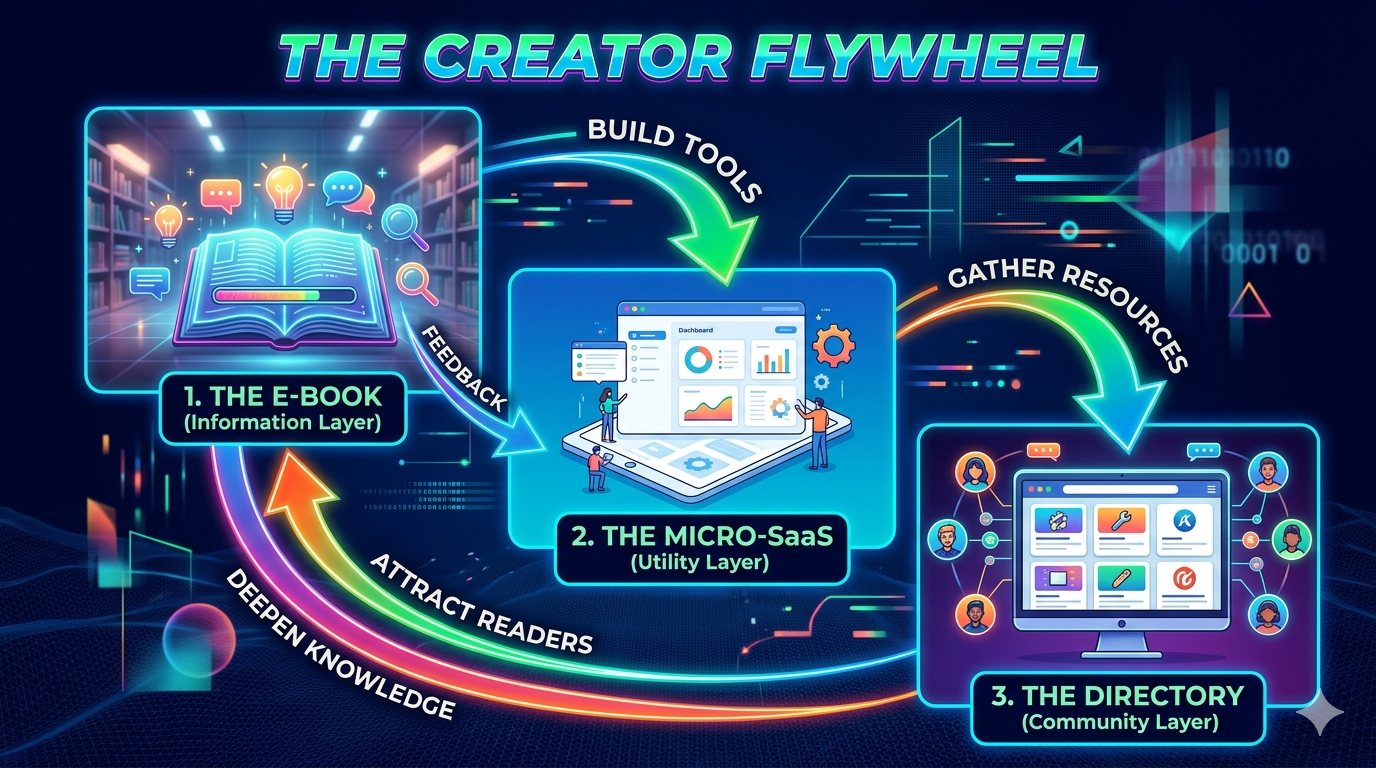
    You have a niche or subject that you maybe write about regularly. Instead of JUST writing about this niche, you build a ‘closed loop’ system where one product naturally leads to the next.

    This is the ‘Creator Flywheel’.

    The One-And-Done Trap

    Most niche creators make the mistake of building a niche product, or just writing about a niche etc. Or maybe they write an ebook, sell it and then look for the next random topic.

    This can get exhausting…

    Here’s where you can make a shift in this trap. Instead of building a library of random topics, you build a full CHAIN related to one niche.. absolutely PACKED full of value.

    It works something like this –>

    • Regularly create content on this specific niche (blog posts etc)
    • Create a lower friction ebook on the niche
    • If applicable, create a small simple tool for this niche
    • Create a network or hub, of curated resources (niche directory)

    Phase 1: The foundational information layer

    Everything starts with specialized knowledge that you’re collecting and packaging together in one spot. An e-book isn’t just a product anymore in this case, it’s your specialized market research on this specific niche.

    1. Identify any ‘pain points’ – after creating this quick guide, see if people are willing to pay a couple bucks for it, $5-15 ish. If people are willing to buy your ebook / guide, they’re signaling that they have a problem that they’re willing to solve.
    2. Make a feedback loop – using any common questions you get from your ebook and blog post readers, map out manually what they’re all struggling with.
    3. Find a way to transition – for instance, if your ebook is a ’10 steps to do *something*, the next logical step MAY be to create a micro tool that automates certain steps, or all the steps. The ebook could be the cheaper method that walks them through, the tool could be the more expensive method that automates it all for them. This leads to the next phase.

    Phase 2: The small tool layer

    This is where you change from telling them how to do it, to doing it for them / automating things. In these days, you dont even need to know how to code to create a simple software anymore.

    Create the minimum viable tool for your niche. It doesn’t need to be complex. If your ebook is about ‘writing SEO headlines’ for example, your micro-tool could be a simple SEO headline generator – based on specific seo title formulas.

    Another reason you should consider making a related tool for your ‘niche ecosystem’ is the STICKY FACTOR. Your tool would provide recurring value. While your e-book does help, and is part of this whole system, a tool is often bookmarked and used frequently.

    Phase 3: The directory & community layer

    Once you’ve created the knowledge (all the blog post articles), and the guide on any related pain points (the e-book), and the tool that automates or helps (micro tool ), you’re quickly becoming the authority in this niche. Now it’s time to build the ‘town square’.

    Next you should create an online directory (either just a page in your existing site, or a seperate site – depending on your situation), and / or a message board area for all your visitors to chat & ask questions / talk about their own experiences.

    The idea for each of these separate parts of your niche ecosystem, is that they all compliment and NEED each other.. They’re all solutions to varying needs of your niche’s audience. Your blog posts and link directory sends traffic to your ebook, your ebook converts to your tool, etc! They all work off each other. This is what becoming an authority in a niche really looks like.

    Phase 4: The psychology behind it all

    Why does this concept work so well?

    • It compounds trust! Once they’ve read a bunch of articles you’ve written, they’ll be MUCH more likely to buy your ebook / they’ll trust your software tool you’ve made as well.
    • Very low customer acquisition costs. You aren’t just throwing money at ads, you’re moving already free traffic / existing fans through a full ecosystem funnel.
    • Valuable if you ever want to sell your brand. A stacked up niche ecosystem is easily worth 5-10 times more to someone wanting to buy it – than any individual part alone.

    My Closing Thoughts:

    This isn’t something you just build overnight. It takes some planning, & lots of listening to your audience and criticisms.

    Start with one high quality blog post or a simple guide, listen to feedback, then start to formulate your ‘master plan’ for a total domination niche takeover! 🙂