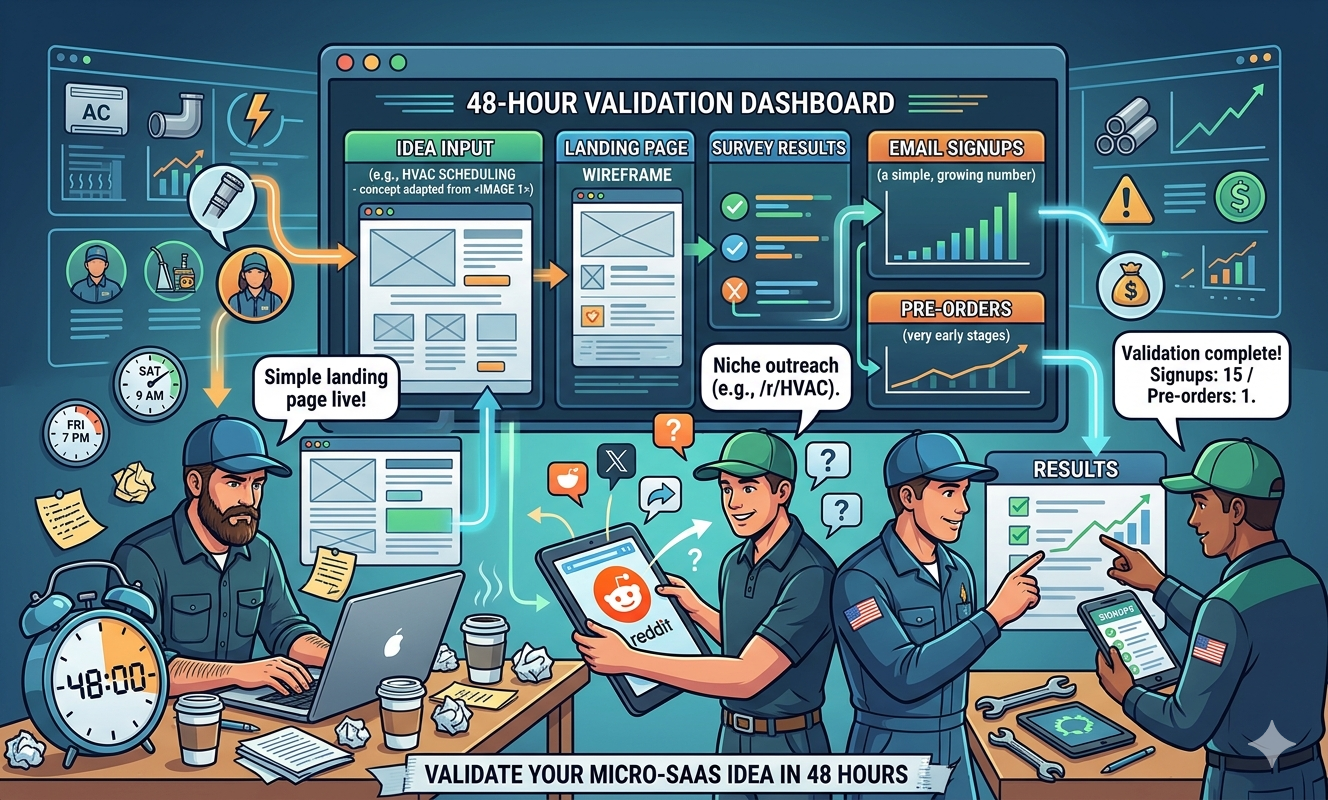
You’ve got a brilliant micro-SaaS idea that keeps you up at night.. But what if you build it and nobody cares? That’s the nightmare that stops most founders before they even start typing the first line of code.
What if you could know in 48 hours whether your idea is worth pursuing?
Most founders waste months building products nobody wants because they skip validation. They fall in love with their solution before proving there’s a problem worth solving. The result? Ghost towns of abandoned side projects and drained bank accounts.
I’ve been there too many times to count. That sinking feeling when you launch to crickets? Yeah, it sucks. But here’s the good news.. you can avoid this pain with a simple 48-hour validation sprint that costs less than a fancy dinner out.
Think of validation as your idea’s immune system — it fights off the bad infections before they spread. When you validate early, you’re not being pessimistic; you’re being smart about where you spend your precious time.
The 48-Hour Validation Sprint: Speed Kills Indecision
Forget lengthy market research reports and endless surveys. Validation isn’t about perfection.. it’s about speed and signal. In two days, you can run enough experiments to get a clear yes/no on whether to build, pivot, or abandon.
Think of it like a medical triage for your idea… quick tests that reveal if there’s life worth saving. The goal isn’t to validate every assumption — just the riskiest one: will people actually pay for this?
When i ran my first validation sprint for a micro-SaaS idea last year, i was shocked at how clear the signals were. By hour 36, i had enough data to make a confident decision. No more guessing, no more “maybe if i just add one more feature…”
The beauty of this approach is that it forces you to confront reality early. Either you get validation that fuels your motivation, or you get a clear signal to pivot or abandon — both outcomes are wins because they save you time.
I like to think of validation as the ultimate test for founder optimism bias. We’re all guilty of seeing our ideas through rose-colored glasses; validation strips those glasses off and shows us the real colors of the market.
Customer Interviews That Don’t Suck
Talk to 5-7 people who match your target customer profile — not friends or family who will lie to spare your feelings. Use the “problem interview” format: ask about their current workflow, pain points, and what they’ve tried to fix it. Listen more than you pitch.
Here’s the script that works...
“Walk me through the last time you dealt with [problem]. What did you do? What sucked about that process? If you could wave a magic wand, what would change?” Take notes, look for emotional language and willingness to pay or switch.
For a micro-SaaS targeting HVAC contractors (as i talked about in my article on The Local Service Micro-SaaS), you’d ask about their scheduling headaches, invoicing pains, or how they track jobs. Listen for those “ugh” moments — that’s your opening.
Pro tip: record these interviews (with permission) so you can focus on listening instead of frantic note-taking. You’ll catch nuances you’d miss otherwise, like tone of voice or hesitation that signals real pain.
Another trick I’ve learned.. : Start each interview by saying you’re not selling anything — you’re just trying to understand their world. This lowers defenses and gets you honest answers about what really bugs them day to day.
I’ve found that the best insights often come from the “what else?” question after you think the interview is over. Keep the recorder running and ask, “Is there anything else about this problem that we haven’t covered?” That’s when the gold often shows up.
Landing Page Test: Fake It Till You Make It (Ethically.. Of Course!)
Build a one-page website that explains your solution, shows pricing, and has a clear call-to-action — usually “Join Waitlist” or “Get Early Access.” You don’t need the product yet; you’re testing whether the promise alone gets people to leave their email.
Use Carrd.co or Leadpages (or even a simple WordPress page) to get something up in an hour. Drive cheap traffic via Reddit ads, Facebook groups, or LinkedIn sponsored content targeting your niche.
Spend $20-50 to get 100-200 visitors.
If you get 10%+ email conversion, you’ve got strong interest. Below 3%? Either your messaging is off or the problem isn’t painful enough. Iterate on the headline and value proposition before deciding.
I’ve seen landing pages convert at 25%+ for well-targeted micro-SaaS ideas in boring niches. The key is specificity — speak directly to one person’s problem, not a vague audience. Your headline should make the ideal customer think “how did they know i was thinking that?!”
Don’t over-complicate the page here.. a clear headline, a short paragraph explaining the solution, bullet points of benefits, pricing info, and the email form. That’s it. Everything else is distraction.
Remember to set up proper tracking so you know where your visitors are coming from. UTM parameters are your friend here — they’ll tell you which ad or post is actually driving interest.
Pre-Sales: The Ultimate Validation To Your Idea
Ask interviewees who lit up during the problem conversation: “If i built this exactly as we discussed, would you buy it today?” If they say yes, hit them with: “Great — can you send $50 to hold your spot for the beta?”
This isn’t about scamming people; it’s about filtering polite interest from real commitment. If they balk at putting skin in the game, dig deeper: is it price, timing, or genuine lack of need? Getting even 2-3 pre-sales validates that someone will actually exchange money for your solution.
When i tested this approach with a developer tool idea, i got three pre-sales at $100 each — that covered my domain and hosting costs for the MVP. Those early customers also became my best advocates, giving feedback that shaped the product in ways i never would have guessed.
Remember: money talks, everything else walks. If people won’t put up even a small amount to validate their interest, you probably don’t have a business — you have a interesting hobby.
One nuance: make it clear that the pre-sale is for a future product and that you’ll deliver or refund if things don’t work out. This builds trust and sets proper expectations. Most people appreciate honesty more than false promises.
How to Interpret Results: Build, Pivot, or Abandon:
After 48 hours, look at your signals:
- Interview consistency: did multiple people describe the same painful problem?
- Landing page conversion: are people excited enough to leave contact info?
- Pre-sales: did anyone actually pull out their wallet?
If you have strong signals across at least two areas, move to building a minimal version. If signals are weak or contradictory, pivot the idea based on what you learned — maybe it’s a different customer segment or a narrower feature set. If there’s near-zero interest, abandon it happily. You just saved yourself months of misery. Or at VERY least, reconsider your angle / problem that you’re solving.
Try Using This Simple Scoring System..
I like to use a simple scoring system: give each signal area 0-2 points (0=none, 1=weak, 2=strong). If you score 4+ points out of 6, you’ve got enough validation to proceed. 2-3 points means pivot time. 0-1 points means abort mission and celebrate the time you saved.
The key insight here is that validation isn’t about proving your idea is perfect — it’s about killing bad ideas fast so you can spend time on the ones that have real legs. Your time is your most limited resource; treat it like the precious asset it is.
I’ve seen founders ignore weak validation signals and build anyway, only to learn the hard way that hope is not a strategy. Trust the process, even when it tells you to walk away from something you love.
Tools That Make Validation Easier
You don’t need fancy equipment to run a validation sprint — just a few smart tools that save you time and headaches.
For interviews: Calendly for scheduling, Zoom or Google Meet for calls, Otter.ai for transcription (free tier works fine). A simple Google Doc or Notion page for notes is plenty.
For landing pages: Carrd.co is stupid simple and cheap ($19/year for pro). If you want more flexibility, try Leadpages or Unbounce — both have free trials. Or spin up a quick WordPress site with a theme like Astra.
For traffic: Facebook Ads Manager lets you target incredibly specific niches (like “people who manage HVAC businesses in Texas”). Reddit ads work well for tech/startup audiences. LinkedIn is gold for B2B micro-SaaS ideas.
For pre-sales: Stripe or PayPal links work fine. Or use Gumroad if you want something that handles delivery later. The key is making it stupid easy for people to give you money.
I keep a validation toolkit bookmarked in my browser — a folder with links to all these services so i can spin up a test in minutes rather than hours. Preparation makes execution painless.
- Day 1 Morning: Run 5 problem interviews using the script above; look for patterns in pain points.
- Day 1 Afternoon: Build a simple landing page with clear value proposition and pricing; set up analytics.
- Day 1 Evening: Drive $20-50 of targeted traffic to the page; monitor sign-up rate.
- Day 2 Morning: Follow up with interview participants who showed high interest; attempt to collect pre-sales.
- Day 2 Afternoon: Review all data; decide to build, pivot, or abandon based on the framework above.
- Day 2 Evening: Document your findings and next steps — even if you abandon, note what you learned for future ideas.
Validation isn’t ‘cool’, but it’s the secret sauce that separates profitable micro-SaaS ventures from expensive hobbies. By forcing yourself to test before you build, you stack the odds in your favor.. and that’s how you build a stack of tiny profitable tools instead of one big complex app (hey, that sounds familiar!).
Hope this helped you in some way, seeya!
Also, I covered this more in depth in my article on The Micro-SaaS Profit Stack: Building Multiple Tiny Profitable Tools Instead of One Large App, where i explain why multiple small bets beat one big swing basically every time..
Oh & also check out my post on The Creator’s AI Toolkit: Using AI Without Becoming AI Slop for how to use AI tools to accelerate each validation step without losing your human edge.