Ok so, here’s something that bugs me about the way most people approach online business..
They pick ONE thing. Maybe it’s an ebook. Maybe it’s a SaaS tool. Maybe it’s a blog with some ads on it. And then they pour everything into that one channel and pray it works out.
And look, i’m not saying that’s always wrong. Single focus is powerful. But here’s what nobody tells you..
What if that ONE niche you already picked could be generating 5 separate income streams — without you doing 5x the work?
Because that’s the actual unlock. It’s not about spreading yourself thin across a dozen random side hustles.
It’s about going deeper into the niche you already understand, and letting each piece of the puzzle feed the next.
I call this Revenue Stacking. And once you see how it works, you’ll wonder why you ever thought you needed a “second business” to diversify.
The Single Stream Trap
Lets say you built a nice little blog about commercial cleaning. You’re getting 10,000 monthly visitors, running some display ads, maybe pulling in $300-$500/month from AdSense or Mediavine.
Not bad. But here’s the problem — you’re sitting on a goldmine of attention and trust, and you’re cashing it in at the lowest possible rate.
Display ads pay you pennies per visitor. That same visitor who’s reading your article about “best commercial floor cleaners” is actively looking for solutions.
They have their wallet out. And you’re showing them a banner ad for car insurance.
That’s the Single Stream Trap. One monetization channel for an audience that would happily pay you in four other ways.
As i talked about in my article on [The Creator Flywheel], the real power comes when each product leads naturally to the next. Revenue Stacking is the financial blueprint behind that concept.
The 5 Revenue Layers (And Why They Compound)
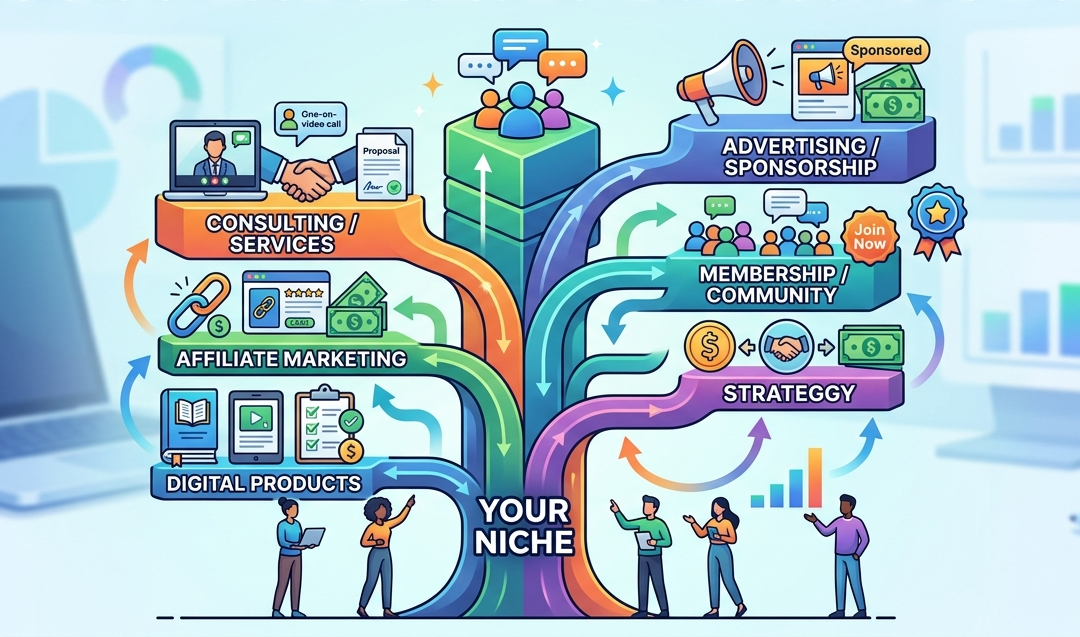
Here’s the framework. Every niche — and i mean every niche, even the boring ones — can support these 5 layers:
Layer 1: Content Revenue (blog ads, affiliate links, sponsored posts)
Layer 2: Digital Products (ebooks, templates, checklists, courses)
Layer 3: Micro-SaaS Tool (one focused software solving ONE painful problem)
Layer 4: Directory or Marketplace (listing fees, featured placements, lead generation)
Layer 5: Community or Membership (monthly access to a curated group + ongoing value)
Now here’s what makes this POWERFUL — each layer doesn’t exist in isolation. They compound.
Your blog content drives traffic. That traffic discovers your ebook. The ebook buyer trusts you enough to try your SaaS tool.
The SaaS tool users want to be listed in your directory. And the directory members want to join the community to network with each other.
It’s a chain. Not 5 separate businesses. One ecosystem.
Let’s Do The Math: A Real Example
Ok lets make this concrete. Imagine you picked the niche of independent HVAC contractors. Boring? Absolutely. Profitable? Spectacularly.
Here’s what your revenue stack could look like after 12-18 months of building:
Layer 1 — The Blog
You write 50-60 articles about HVAC business topics. Marketing tips for contractors. How to handle seasonal slowdowns.
Best CRM tools for small HVAC shops. etc etc.
At 15,000 monthly visitors with decent ad placement, you’re pulling in roughly $400-$800/month in display ad revenue. Plus maybe $200-$400/month in affiliate commissions from tools you recommend.
–> Estimated: $600-$1,200/month
Layer 2 — The Ebook Bundle
You package your best content into a practical guide. “The HVAC Contractor’s Marketing Playbook” — 80 pages, real examples, step-by-step. Sell it for $29 on Gumroad.
As i covered in my [24 Hour Product Sprint](https://www.joshkatherman.com/24-hour-product-sprint-launch-your-first-sellable-e-book-by-tomorrow/) post, you can literally build this in a weekend from content you’ve already written.
At 30-50 sales per month (your blog is the funnel), that’s:
–> Estimated: $870-$1,450/month
Layer 3 — The Micro-SaaS Tool
You noticed from your blog comments and emails that HVAC contractors are TERRIBLE at follow-up quotes. They give a quote, then forget to follow up, and lose the job to whoever texts back first.
So you build a simple quote follow-up tool using no-code (Softr + Supabase + Make.com). Contractor enters a quote, the tool auto-sends follow-up texts at Day 1, Day 3, and Day 7.
Charge $19/month.
This is exactly the kind of Minimum Viable Solution i talked about in my [MVS Framework](https://www.joshkatherman.com/the-minimum-viable-saas-framework-how-to-build-profitability-not-complexity/) article. One problem. One tool. Done.
At 80-120 subscribers:
–> Estimated: $1,520-$2,280/month
Layer 4 — The Directory
You launch “TrustedHVAC.com” — a human-vetted directory of quality HVAC contractors. You personally verify licenses, check reviews, even do shadow calls.
Charge contractors $49/month for a premium listing, or $29/month for basic.
The blog drives homeowners TO the directory. The directory drives contractors BACK to your blog. Beautiful loop.
At 40-70 paying contractors:
–> Estimated: $1,160-$3,430/month
Layer 5 — The Community
You create “The HVAC Business Circle” — a private Slack or Discord group for contractors in your directory. Monthly Q&A sessions, shared leads in their area, seasonal strategy discussions. $15/month.
At 50-100 members:
–> Estimated: $750-$1,500/month
Let’s add it up at the LOW end:
— Content Revenue: $600/month
— Digital Products: $870/month
— Micro-SaaS: $1,520/month
— Directory: $1,160/month
— Community: $750/month
Total: $4,900/month from ONE niche.
And that’s the conservative estimate. The high end pushes past $8,800/month. From a “boring” HVAC niche. No venture capital. No team of 12.
Just you, building deliberately and tactically. Pretty cool right?
Why This Beats The “5 Side Hustles” Approach
I see people all the time trying to diversify by starting completely separate businesses. They’ve got a blog over here, a dropshipping store over there, some freelance work on the side..
Maybe a YouTube channel about something totally unrelated.
That’s not diversification. That’s dilution.
When you stack revenue within ONE niche, you get three massive advantages:
1. Shared Audience
Every customer you acquire serves ALL five layers. One marketing effort, five revenue streams. You’re not starting from zero every time you launch something new.
2. Compounding Trust
Each product builds credibility for the next. Someone who reads your blog AND bought your ebook AND uses your tool?
They will absolutely pay for your directory listing. They already trust you. The sale is practically made before you even pitch it.
This is what i was getting at with the concept of [Identity Marketing] … you’re not just selling products, you’re becoming the go-to person in that world. The niche becomes part of your identity and your customers’ identity.
3. Lower Churn Across The Board
Here’s one people don’t think about. When a customer is using your SaaS tool AND listed in your directory AND a member of your community.. they’re not going anywhere.
The switching cost is massive — not because you’ve locked them in, but because the value of staying is so high.
Compare that to a standalone SaaS with 5-8% monthly churn. When you’re woven into someone’s business across multiple touchpoints, churn drops to basically nothing.
The Build Order (Don’t Skip This!!)
Now, here’s where most people mess this up. They try to launch all 5 layers at once. That’s a recipe for burnout and half-finished products.
Here’s the order i’d recommend:
Phase 1 (Months 1-3): Content Only
Build your blog. Write 20-30 cornerstone articles. Establish topical authority.
Get your first 5,000 monthly visitors. No monetization yet except maybe basic affiliate links.
This is your content base — and if you want to understand why this step is non-negotiable, check out my post on [Building Your Content Base].
Phase 2 (Months 3-6): Add Digital Products
Package your best content into an ebook or template bundle. This is the lowest-effort revenue layer and validates that people will actually pay you in this niche.
Phase 3 (Months 6-9): Build The Micro-SaaS
By now you know your audience’s pain points from blog comments, emails, and ebook buyer feedback. Build the simplest possible tool that solves their #1 frustration. No-code is your friend here.
Phase 4 (Months 9-12): Launch The Directory
You’ve got traffic, products, and a tool. Now create the directory that connects service providers with customers. Your existing audience is your launch base.
Phase 5 (Months 12-18): Open The Community
The community is LAST because it only works when you already have enough engaged users to make it valuable.
A community with 5 people is a ghost town. A community with 80+ people who already use your products? That’s a room full of people who want to talk shop.
Your Revenue Stack Starter Checklist
Here’s your action plan. Pick your niche (or use the one you’ve already got) and map this out:
- Identify your niche’s top 20 questions people search for (this becomes your content plan)
- List the 3 biggest frustrations your audience has with existing tools or processes (this becomes your SaaS idea)
- Find 1 existing piece of content you could expand into a $19-$39 ebook
–> Research whether a quality directory exists in your niche (spoiler: it probably doesn’t)
–> Talk to 5-10 people in your niche and ask what community or network they wish existed
–> Write down your Phase 1 content calendar for the first 30 days
–> Set a revenue target for each layer at the 12-month mark
Don’t try to do everything at once. The whole point of stacking is that each layer builds on the last. Start with content. Let the audience tell you what they need next.
You don’t need five businesses to build five income streams. You need one niche and the patience to build it layer by layer.
The revenue stack isn’t a hack. It’s not a shortcut. It’s just the mathematically obvious approach once you stop thinking about “products” and start thinking about ecosystems.
Every article you write, every tool you build, every directory listing you verify — they all feed each other. And over time, that compounding effect turns a “boring” niche into something that generates real, diversified income.
So pick your niche. Start stacking. And stop trying to juggle five unrelated side hustles when one focused ecosystem can outperform all of them combined.
Hope this helped you think about your niche in a new way.. take care! 🙂