Tag: Niche

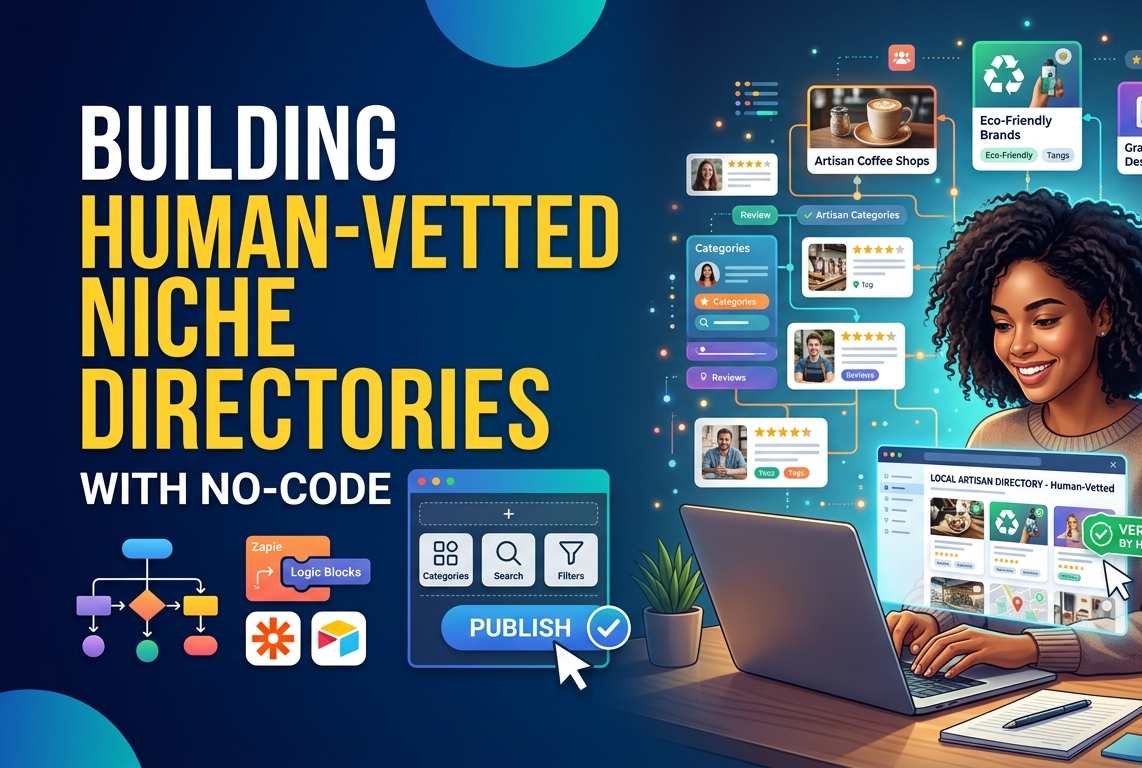
  • Building Human-Vetted Niche Directories with No-Code

    Building Human-Vetted Niche Directories with No-Code

    So, let’s say you’re trying to find a.. reliable mold specialist in your area. You open Google, scroll through pages of Yelp reviews that all sound suspiciously similar, and wonder which ones are actually written by real humans who’ve had real experiences…

    This is becoming an actual REAL problem.

    These days where AI-generated fake reviews are flooding every directory and review site, trust is officially broken. People are desperate for sources they can actually believe in…especially when it comes to important decisions about their homes, health, businesses & wealth.

    Here’s my thought.. human-vetted niche directories aren’t just a convenient concept anymore.. they’re becoming the biggest passive income opportunity of 2026. And the best part is that you don’t need to know how to code to build one anymore!

    The Trust Crisis in Online Directories

    Let’s talk about why traditional directories like Yelp, Angie’s List, and even Google Maps are losing credibility fast..

    It’s not just about a few fake reviews here and there.. we’re talking about full systematic, AI-generated content designed to manipulate rankings and trick consumers.

    These fake reviews aren’t just annoying.. they’re actually dangerous.. When someone’s choosing a contractor for electrical work or a longevity clinic for hormone therapy, fake positive reviews can lead to real harm.

    The verification systems these big platforms use are outdated, easily gamed, and completely overwhelmed by the scale of AI content flooding in.

    What we’re seeing is a complete reversal of what made directories valuable in the first place. Instead of being trusted hubs of local knowledge, they’ve become marketplaces where the loudest (or most AI-optimized) voice wins.. not the most honest or experienced reviews.

    The Human-Vetted Alternative: Trust Hubs

    Enter the human-vetted niche directory, what I like to call a “trust hub.” This isn’t just another directory with a fancy verification badge.. No no! It’s a carefully curated ecosystem where every single listing has been manually verified by a real human who understands the industry / niche and can provide actual valuable insight into which companies may work best for them.

    Think of it like this.. instead of trusting an algorithm to spot fake reviews, you’re trusting a person who actually knows what legitimate work looks like in that specific niche. They’re checking licenses, making shadow calls, verifying insurance, and looking for those subtle tells that separate the pros from the pretenders.

    And because you’re focusing on a specific niche.. let’s say, sustainable home retrofitting.. AI compliance consulting, you can go deep. You’re not trying to be everything to everyone, you’re becoming the definitive authority in one specific area where trust is one of, if not the most important thing!

    Why No-Code Tools Are Perfect for This

    Now, you might be thinking: “This sounds great, but building and maintaining a directory with manual verification sounds like a ton of work.” And you would be right.. if you were trying to code everything from scratch.

    But here’s where modern no-code tools change the game completely. With platforms like Softr, Airtable, and Make.com, you can build a sophisticated directory with automated workflows that handle 80% of the grunt work, leaving you free to focus on the high-value human verification tasks.

    Let me break down how this actually works in practice:

    Airtable becomes your backbone—it’s where you store all your business listings, verification notes, license documents, and communication history. You can set up different views for pending verification, approved listings, and expired certifications.

    Softr turns that Airtable base into a beautiful, searchable directory website with zero coding. Members can search by location, specialty, or certification level, and you get built-in user accounts, payment processing, and SEO optimization.

    Make.com (formerly Integromat) handles the automation magic—it can automatically check license expiration dates, send renewal reminders to businesses, trigger verification workflows when new listings come in, and even pull in public data from government databases to pre-fill application forms.

    The Verification Workflow That Actually Scales

    This is where most people get stuck—they imagine having to manually verify every single aspect of every business, which obviously doesn’t scale. But the trick is to create a tiered verification system that focuses human effort where it matters most.

    Here’s how I would personally structure this:

    First, automate everything you can. Use Make.com to check if a business license exists in state databases, verify basic insurance coverage through public records, and scrape websites for service area and contact information.

    Second, create a verification checklist that your human verifiers actually use. This isn’t just “does this business exist?”—it’s specific, actionable items like:

    • Does their license match the services they advertise?
    • Have there been any complaints filed with the state licensing board?
    • Do they carry the specific types of insurance needed for this type of work?
    • Can we verify at least two recent customer references through direct contact?

    Third, batch your verification work. Instead of verifying one listing at a time, set aside specific verification blocks where you process 10-15 applications in a row. This builds efficiency and helps you spot patterns or red flags that might be missed when verifying sporadically.

    Making It Profitable: The Trust Premium

    Now let’s talk potential cash flow.. because if this isn’t profitable, it’s just a hobby. The beauty of human-vetted directories is that you can charge premium prices precisely because you’re offering something the AI-powered giants can’t: genuine trust.

    For niches like emergency home infrastructure (plumbing, electrical, HVAC), longevity/wellness clinics, or AI compliance consulting, businesses are often paying $50-200 per qualified lead. When you can demonstrate that your leads come with a human-verified trust badge, conversion rates go through the roof.

    I’d recommend starting with a free basic listing to build initial traction, then offering tiered paid options:

    • Free: Basic NAP (name, address, phone) with limited visibility
    • Verified ($49/month): Includes human verification badge, priority placement, and lead notifications
    • Premium Verified ($99/month): All verified features plus featured placement, analytics, and direct booking options

    The key insight here is that you’re not just selling directory placement, you’re selling risk reduction! For businesses in high-trust niches, that verification badge means they stand out in a sea of unverified competitors and can justify higher prices themselves.

    Getting Started: Your First 30 Days

    Okay, let’s get practical. If you’re excited about this opportunity, here’s exactly how I’d approach building your first human-vetted niche directory in the first month:

    • Week 1: Pick your niche and research the verification requirements. What licenses matter? What are the common pain points customers have finding trustworthy providers? Join 2-3 Facebook groups or forums in your niche to listen to real conversations.
    • Week 2: Set up your Airtable base with fields for business info, verification status, license numbers, insurance details, and notes. Build your Softr site using a directory template—focus on clean search and mobile responsiveness first.
    • Week 3: Create your verification workflow in Make.com. Start simple: automate license checks and expiration reminders. Design your verification checklist based on what you learned in week 1.
    • Week 4: Onboard your first 10-15 businesses manually. This part is crucial, you want to refine your verification process with real applications before worrying about scale. Ask for feedback on both the application process and the value they’re seeing from being listed.

    Have you thought about making your own human-vetted niche directory? If so let me know how it’s going, or if you have any questions below! Take care – Josh

  • Human-Vetted Directories in the AI Era – Combine Trust & Automation

    Human-Vetted Directories in the AI Era – Combine Trust & Automation

    Ok so… imagine running a niche directory where every listing feels like a personal recommendation from a trusted friend.. That’s the magic of human-vetted trust hubs — they turn casual browsers into loyal customers because the vetting process itself builds credibility.

    But here’s the thing.. as AI floods the web with auto-generated listings and fake reviews, maintaining that human touch feels harder than ever. You might worry that scaling your directory means sacrificing the very trust that makes it valuable.

    What if you could use AI to handle the grunt work while keeping humans in the loop for final approval?

    The Trust vs Scale Dilemma

    Most directory owners hit a ceiling when they try to grow beyond a hundred listings.. Manual verification eats up time, and hiring a team quickly erodes profits.. Meanwhile, AI-powered aggregation tools can scrape thousands of data points in minutes, but they lack judgment — they can’t tell if a business is legit or just a clever facade.

    This tension isn’t new, but AI makes it sharper.. On one side, you have the authenticity that only human vetting provides; on the other, the scalability that automation promises.. The solution isn’t choosing one over the other — it’s designing a workflow where each does what it does best.

    Let me explain.. Think about a local plumbing directory — you could spend hours calling each business to verify licenses and insurance, or you could let AI pull data from state contractor boards and online reviews in seconds.. But only a human can tell if that “licensed” plumber actually shows up on time and fixes leaks properly.

    I’ve seen this play out in concrete terms: a directory owner I know spent three months manually verifying 120 listings for a home renovation niche.. By month four, burnout hit, and verification quality dropped.. Then they brought in an AI-assisted workflow and doubled their output while actually improving accuracy — because humans focused on judgment calls, not data gathering.

    AI as the Data Scout

    Think of AI as your tireless intern who loves digging through public records, social media, and review sites.. It can pull business names, addresses, phone numbers, and even sentiment analysis from existing reviews at scale.. For example, you could use AI to:

    • Aggregate basic info from Google Maps, Yelp, and industry-specific sources
    • Flag potential duplicates or inconsistent NAP (name, address, phone) data
    • Detect obvious red flags like missing websites, generic templates, or sudden spikes in negative sentiment

    The key is treating AI output as raw material, not finished product.. You still need a human to interpret context — like knowing that a “missing website” might be fine for a decades-old plumbing shop that relies on word-of-mouth.

    I’ve seen this work beautifully in HVAC directories where AI gathers service areas and certifications, but humans verify that technicians actually have the right equipment for commercial vs residential jobs.

    I’ll give you a concrete example: imagine you’re building a directory for licensed electricians in older neighborhoods.. AI can quickly pull license numbers from the state database, check for any disciplinary actions, and gather online reviews.. But a human verifier might notice that while the license is current, the business has changed ownership twice in the last year — something that could affect consistency of service.. Or they might see that the address listed is actually a residential home, raising questions about whether it’s a legitimate commercial operation.

    The Human Verification Gate

    Now picture a simple but powerful checkpoint: after AI gathers and pre-processes a listing, a real person reviews it before it goes live.. This doesn’t have to be slow if you design it right.. Use a lightweight internal tool (think Airtable or Softr) where reviewers see:

    • The AI-collected data highlighted for quick scanning
    • Any discrepancies or warnings the system flagged
    • Links to original sources for spot-checking

    A trained verifier can make a call in under two minutes per listing.. More importantly, they can apply nuance — like recognizing that a business with a sparse online presence might still be highly reputable in its local community.

    Here’s the thing about human judgment: it catches the subtle stuff AI misses.. Like when a business has perfect online ratings but multiple verifiers mention rude technicians — or vice versa, where a grizzled contractor with a barebones website has decades of proven results.

    I remember working on a directory for historic home restoration contractors.. The AI kept flagging businesses with low Google review counts as risky.. But our human reviewers kept approving them because they knew these specialists get most of their work through referrals from architects and preservation societies — not online searches.. If we’d relied solely on AI, we’d have missed some of the best craftsmen in the field.

    Closing the Loop with Feedback

    Here’s where the flywheel starts spinning: every human decision feeds back into the AI, making it smarter over time.. If reviewers consistently reject certain types of listings, you can adjust the AI’s scoring model to pre-filter those out.. Conversely, if the AI keeps missing legit businesses that humans approve, you expand its data sources or tweak its parameters.

    This creates a virtuous cycle where automation handles volume, humans ensure quality, and the system gets better at predicting what’ll pass inspection.. Over time, you’ll spend less time on each listing and more on growing your directory’s reach and revenue streams.

    I like to think of it as teaching the AI through examples — each “approved” or “rejected” stamp becomes a data point that refines its understanding of what quality looks like in your specific niche.

    For instance, after a few months of human verification, you might discover that your AI is overly cautious about businesses that operate primarily through Facebook pages rather than traditional websites.. You can then adjust the algorithm to weigh social media presence more heavily, reducing false positives.. Or you might find that certain address formats in rural areas are consistently flagged as incorrect when they’re actually perfectly valid — another pattern to teach the AI.

    I’ve watched this feedback loop transform a directory’s efficiency: early on, humans reviewed 80% of AI-suggested listings; after six months of tuning, that dropped to 30%, freeing up verifiers to focus on edge cases and new niches.

    Actionable Steps to Build Your Hybrid Directory

    • Start with a clear niche and define your verification criteria (license checks, social proof, etc.)
    • Choose an AI tool or script for initial data gathering (Python with Selenium, Apify, or even no-code scrapers)
    • Set up a simple review interface where humans can approve, reject, or request more info
    • Log every decision and use it to refine your AI’s accuracy weekly
    • Publish only after human sign-off, and display a “Verified by Humans” badge to reinforce trust

    Pro tip: Begin with a micro-niche — like “licensed electricians in historic districts” or “organic coffee roasters with direct trade relationships” — to prove your model before expanding.

    I’ve seen folks try to boil the ocean and get overwhelmed.. Trust me, it’s way better to start small, prove your workflow, and then scale.. You’ll learn what your human verifiers actually need to see, what the AI struggles with, and how to tune the feedback loop.. Once you’ve got that down, expanding to related niches becomes much smoother.

    I’ll share a quick story: a friend launched a directory for sustainable building materials.. They began with just reclaimed wood suppliers in their metro area.. After nailing the verification process there, they added solar installers, then eco-friendly paints, and now they’re approaching a full green building directory — all because they validated the model first.

    Bigger Picture: Trust Is Your Moat

    In a world where anyone can spin up a directory with AI-generated content, your commitment to real human oversight becomes your competitive advantage.. It’s not just about preventing spam — it’s about signaling to users that you care enough to put eyes on every listing.. That signal builds loyalty, reduces churn, and opens doors to premium monetization like lead sales or featured placements.

    Think about it — when was the last time you trusted a list of “top 10 dentists” that was clearly auto-generated? Now imagine seeing a badge that says “Each dentist verified by a human for license status and patient reviews.” Suddenly, that directory feels worth paying attention to.

    I’ll let you in on a little secret: the most successful directory owners I know don’t compete on quantity — they compete on quality and trust.. They know that in niches like emergency home services, longevity wellness, or AI compliance, users are willing to pay a premium or go out of their way to find a source they can truly believe in..

    And here’s the kicker — this human-first approach actually makes your directory more resistant to AI disruption.. As AI-generated content floods the internet, your verified human stamp becomes a beacon of reliability that algorithms can’t fake.. You’re not just building a directory; you’re building trust infrastructure.

    So embrace the bots for the busywork, but keep the final say where it belongs: with people who understand that trust isn’t a feature — it’s the foundation..

    i’m excited to see what you build with this approach — go make something real!

    Take care guys! 🙂

  • Stack Your Revenue: How One Niche Can Generate 5 Income Streams Without 5x The Work

    Stack Your Revenue: How One Niche Can Generate 5 Income Streams Without 5x The Work

    Ok so, here’s something that bugs me about the way most people approach online business..

    They pick ONE thing. Maybe it’s an ebook. Maybe it’s a SaaS tool. Maybe it’s a blog with some ads on it. And then they pour everything into that one channel and pray it works out.

    And look, i’m not saying that’s always wrong. Single focus is powerful. But here’s what nobody tells you..

    What if that ONE niche you already picked could be generating 5 separate income streams — without you doing 5x the work?

    Because that’s the actual unlock. It’s not about spreading yourself thin across a dozen random side hustles.

    It’s about going deeper into the niche you already understand, and letting each piece of the puzzle feed the next.

    I call this Revenue Stacking. And once you see how it works, you’ll wonder why you ever thought you needed a “second business” to diversify.

    The Single Stream Trap

    Lets say you built a nice little blog about commercial cleaning. You’re getting 10,000 monthly visitors, running some display ads, maybe pulling in $300-$500/month from AdSense or Mediavine.

    Not bad. But here’s the problem — you’re sitting on a goldmine of attention and trust, and you’re cashing it in at the lowest possible rate.

    Display ads pay you pennies per visitor. That same visitor who’s reading your article about “best commercial floor cleaners” is actively looking for solutions.

    They have their wallet out. And you’re showing them a banner ad for car insurance.

    That’s the Single Stream Trap. One monetization channel for an audience that would happily pay you in four other ways.

    As i talked about in my article on [The Creator Flywheel], the real power comes when each product leads naturally to the next. Revenue Stacking is the financial blueprint behind that concept.

    The 5 Revenue Layers (And Why They Compound)

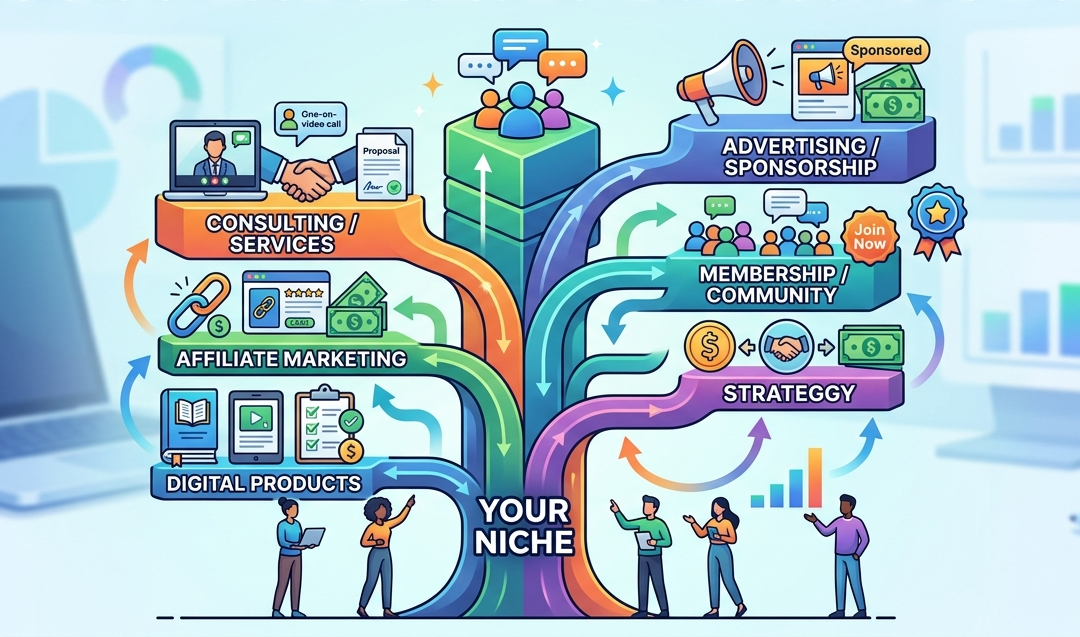
    Here’s the framework. Every niche — and i mean every niche, even the boring ones — can support these 5 layers:

    Layer 1: Content Revenue (blog ads, affiliate links, sponsored posts)

    Layer 2: Digital Products (ebooks, templates, checklists, courses)

    Layer 3: Micro-SaaS Tool (one focused software solving ONE painful problem)

    Layer 4: Directory or Marketplace (listing fees, featured placements, lead generation)

    Layer 5: Community or Membership (monthly access to a curated group + ongoing value)

    Now here’s what makes this POWERFUL — each layer doesn’t exist in isolation. They compound.

    Your blog content drives traffic. That traffic discovers your ebook. The ebook buyer trusts you enough to try your SaaS tool.

    The SaaS tool users want to be listed in your directory. And the directory members want to join the community to network with each other.

    It’s a chain. Not 5 separate businesses. One ecosystem.

    Let’s Do The Math: A Real Example

    Ok lets make this concrete. Imagine you picked the niche of independent HVAC contractors. Boring? Absolutely. Profitable? Spectacularly.

    Here’s what your revenue stack could look like after 12-18 months of building:

    Layer 1 — The Blog

    You write 50-60 articles about HVAC business topics. Marketing tips for contractors. How to handle seasonal slowdowns.

    Best CRM tools for small HVAC shops. etc etc.

    At 15,000 monthly visitors with decent ad placement, you’re pulling in roughly $400-$800/month in display ad revenue. Plus maybe $200-$400/month in affiliate commissions from tools you recommend.

    –> Estimated: $600-$1,200/month

    Layer 2 — The Ebook Bundle

    You package your best content into a practical guide. “The HVAC Contractor’s Marketing Playbook” — 80 pages, real examples, step-by-step. Sell it for $29 on Gumroad.

    As i covered in my [24 Hour Product Sprint](https://www.joshkatherman.com/24-hour-product-sprint-launch-your-first-sellable-e-book-by-tomorrow/) post, you can literally build this in a weekend from content you’ve already written.

    At 30-50 sales per month (your blog is the funnel), that’s:

    –> Estimated: $870-$1,450/month

    Layer 3 — The Micro-SaaS Tool

    You noticed from your blog comments and emails that HVAC contractors are TERRIBLE at follow-up quotes. They give a quote, then forget to follow up, and lose the job to whoever texts back first.

    So you build a simple quote follow-up tool using no-code (Softr + Supabase + Make.com). Contractor enters a quote, the tool auto-sends follow-up texts at Day 1, Day 3, and Day 7.

    Charge $19/month.

    This is exactly the kind of Minimum Viable Solution i talked about in my [MVS Framework](https://www.joshkatherman.com/the-minimum-viable-saas-framework-how-to-build-profitability-not-complexity/) article. One problem. One tool. Done.

    At 80-120 subscribers:

    –> Estimated: $1,520-$2,280/month

    Layer 4 — The Directory

    You launch “TrustedHVAC.com” — a human-vetted directory of quality HVAC contractors. You personally verify licenses, check reviews, even do shadow calls.

    Charge contractors $49/month for a premium listing, or $29/month for basic.

    The blog drives homeowners TO the directory. The directory drives contractors BACK to your blog. Beautiful loop.

    At 40-70 paying contractors:

    –> Estimated: $1,160-$3,430/month

    Layer 5 — The Community

    You create “The HVAC Business Circle” — a private Slack or Discord group for contractors in your directory. Monthly Q&A sessions, shared leads in their area, seasonal strategy discussions. $15/month.

    At 50-100 members:

    –> Estimated: $750-$1,500/month

    Let’s add it up at the LOW end:

    — Content Revenue: $600/month

    — Digital Products: $870/month

    — Micro-SaaS: $1,520/month

    — Directory: $1,160/month

    — Community: $750/month

    Total: $4,900/month from ONE niche.

    And that’s the conservative estimate. The high end pushes past $8,800/month. From a “boring” HVAC niche. No venture capital. No team of 12.

    Just you, building deliberately and tactically. Pretty cool right?

    Why This Beats The “5 Side Hustles” Approach

    I see people all the time trying to diversify by starting completely separate businesses. They’ve got a blog over here, a dropshipping store over there, some freelance work on the side..

    Maybe a YouTube channel about something totally unrelated.

    That’s not diversification. That’s dilution.

    When you stack revenue within ONE niche, you get three massive advantages:

    1. Shared Audience

    Every customer you acquire serves ALL five layers. One marketing effort, five revenue streams. You’re not starting from zero every time you launch something new.

    2. Compounding Trust

    Each product builds credibility for the next. Someone who reads your blog AND bought your ebook AND uses your tool?

    They will absolutely pay for your directory listing. They already trust you. The sale is practically made before you even pitch it.

    This is what i was getting at with the concept of [Identity Marketing] … you’re not just selling products, you’re becoming the go-to person in that world. The niche becomes part of your identity and your customers’ identity.

    3. Lower Churn Across The Board

    Here’s one people don’t think about. When a customer is using your SaaS tool AND listed in your directory AND a member of your community.. they’re not going anywhere.

    The switching cost is massive — not because you’ve locked them in, but because the value of staying is so high.

    Compare that to a standalone SaaS with 5-8% monthly churn. When you’re woven into someone’s business across multiple touchpoints, churn drops to basically nothing.

    The Build Order (Don’t Skip This!!)

    Now, here’s where most people mess this up. They try to launch all 5 layers at once. That’s a recipe for burnout and half-finished products.

    Here’s the order i’d recommend:

    Phase 1 (Months 1-3): Content Only

    Build your blog. Write 20-30 cornerstone articles. Establish topical authority.

    Get your first 5,000 monthly visitors. No monetization yet except maybe basic affiliate links.

    This is your content base — and if you want to understand why this step is non-negotiable, check out my post on [Building Your Content Base].

    Phase 2 (Months 3-6): Add Digital Products

    Package your best content into an ebook or template bundle. This is the lowest-effort revenue layer and validates that people will actually pay you in this niche.

    Phase 3 (Months 6-9): Build The Micro-SaaS

    By now you know your audience’s pain points from blog comments, emails, and ebook buyer feedback. Build the simplest possible tool that solves their #1 frustration. No-code is your friend here.

    Phase 4 (Months 9-12): Launch The Directory

    You’ve got traffic, products, and a tool. Now create the directory that connects service providers with customers. Your existing audience is your launch base.

    Phase 5 (Months 12-18): Open The Community

    The community is LAST because it only works when you already have enough engaged users to make it valuable.

    A community with 5 people is a ghost town. A community with 80+ people who already use your products? That’s a room full of people who want to talk shop.

    Your Revenue Stack Starter Checklist

    Here’s your action plan. Pick your niche (or use the one you’ve already got) and map this out:

    • Identify your niche’s top 20 questions people search for (this becomes your content plan)
    • List the 3 biggest frustrations your audience has with existing tools or processes (this becomes your SaaS idea)
    • Find 1 existing piece of content you could expand into a $19-$39 ebook

    –> Research whether a quality directory exists in your niche (spoiler: it probably doesn’t)

    –> Talk to 5-10 people in your niche and ask what community or network they wish existed

    –> Write down your Phase 1 content calendar for the first 30 days

    –> Set a revenue target for each layer at the 12-month mark

    Don’t try to do everything at once. The whole point of stacking is that each layer builds on the last. Start with content. Let the audience tell you what they need next.

    You don’t need five businesses to build five income streams. You need one niche and the patience to build it layer by layer.

    The revenue stack isn’t a hack. It’s not a shortcut. It’s just the mathematically obvious approach once you stop thinking about “products” and start thinking about ecosystems.

    Every article you write, every tool you build, every directory listing you verify — they all feed each other. And over time, that compounding effect turns a “boring” niche into something that generates real, diversified income.

    So pick your niche. Start stacking. And stop trying to juggle five unrelated side hustles when one focused ecosystem can outperform all of them combined.

    Hope this helped you think about your niche in a new way.. take care! 🙂

  • Don’t Find A Niche, Become The Niche

    Don’t Find A Niche, Become The Niche

    In a saturated market, being ‘you’ is your strategic advantage

    In this digital gold rush we’re all in, the majority of creators are sprinting towards the same exact crowded hills. They want to be a great ‘digital marketer’ or a ‘pro SaaS developer’ etc.

    The problem with this methodology?

    There are literally MILLIONS of other people with those exact same goals. When you’re competing on a completely level playing field with everyone else, you’re just another cog in the whole system..

    If you’re a generalist, you’re typically quite replaceable.. unfortunately. If you can easily be replaced, your leverage decreases. This is where this strategy comes into play.

    The personal niche monopoly strategy is your escape hatch. It’s the art of combining two or more skills or interests until you become a lot more ‘rare’. You don’t want to be the best, preferably you want to be the ‘only’.

    Most people try to get 1% better at something, a single skill or whatever it may be.. They’ll spend countless hours, sometimes a lot of money, trying to go from the top 20% of their niche to the top 10 or 5%. It’s a grueling and uphill battle against people of high intellectual capabilities.

    This strategy uses different math.. instead of just trying to ‘be the best coder’, it’s about skill stacking to create a unique ‘bundle’ of skills that make it infinitely easier to be the ‘best’ at. Instead of competing against thousands and thousands of other people doing the same thing, you’re suddenly competing maybe against a couple of people, and in some cases no one else. The more unique and specific your skill combo is, the less competition you have. So the goal is to not get so specific that you only target 10 people worldwide, but not so wide that you’re competing with too many.

    Really think about this concept for a minute… Ok so, for example, let’s toss out an example of using this strategy to really work out what it looks like in reality.

    Imagine you’re in the top 20% of people who do online directories.. While that’s still quite good, but not overly unique.

    Now in comparison, imagine that you’re ALSO in the top 20% of people who understand ‘local SEO for plumbers’. Suddenly the pool of people who understand both is tiny.

    When you apply directory models specifically to the plumbing industry, you’ve created a unique personal monopoly on this niche.

    Finding Your Own ‘YOU’ Niche

    The secret to successfully creating your own personal monopoly is commonly found in the places that other people are not looking.

    Everyone wants to build the next social media app or tool, but that’s what all the other people are are doing. The REAL money, are built in the ‘boring’ highly specific niches.

    Just think about the legacy industries.. Logistics, local governments, specialized medical billings, industrial supply chains etc etc. These industries are commonly running software from the 90s and marketing strategies that are even older!

    When you bring modern concepts to aged industries, you can be so much more than just a service provider, you can be a revolutionary. Your own personal monopoly is protected by a barrier of boredom, in a sense. Your competitors aren’t attacking your unique niche you’ve carved out because it’s not attractive enough for them to notice.

    Just ponder if you ‘vibe coded’ an inventory / sales app system for a very specific niche industry.. To branch from our previous idea, lets say you create a customer acquisition / tracking / marketing system that’s SPECIFICALLY for any local ‘single person’ plumbers, that helps them keep track of their customers, reach out for marketing etc etc, maybe even billing too.

    If you created this system, you could directly market this highly niche software to every single ‘freelance’ plumber (is that what they’re even called?). This would be something that you could charge monthly for, and can also swap the ‘plumber’ out for any other industry, and make more and more niche apps.. all charging a monthly fees. You can see how this could potentially pile up your monthly reoccurring revenue quickly!

    Your ‘Human-First’ Advantage

    In a landscape being flooded with generic AI slop, your voice is your ultimate intellectual tool!

    Your personal niche monopoly isn’t just about WHAT you do, it’s also about HOW you do it. This is where the human-first methodology becomes a tactical weapon. When you manually create top notch articles and ideas, inject your own personal stories & bypass the robotic tone of the masses, you build a brand that can’t be scraped or duplicated by a bot or AI.

    Your monopoly is secured when your audience stops looking for just ‘a solution’, and starts looking for YOUR solution. People have greater trust for unique HUMAN created perspectives.

    Owning Your Unique Niche

    Once you’ve identified your own personal niche monopoly, the goal is to own the whole stack of the niche. For instance, let’s say that your monopoly is a micro-SaaS for boutique coffee roasters..

    You would create your website on this, populated with a bunch of articles speaking of all variations under that unique niche. Also populated with reviews of coffee roasters, comparisons etc

    You would also create a directory, building the PRIMARY database of.. lets say, ethically sourced bean suppliers.

    You would then ALSO create some sort of a software or tool that’s related (ok maybe this wasn’t the best niche idea because i can’t think of a software for this!).. but you get the idea!

    By vertically integrating these unique concepts, you become the beginning, middle and end of the conversation in this niche. You will have completely owned this niche, and Google and other web searches will notice this & rank you accordingly as well.

    Starting Your Own Niche Monopoly

    You won’t need a 3000 page business plan to start, you’ll only need an intersection of ideas.

    • Audit your hobbies and your oddities: What’s a hobby or skill that you have that ‘doesn’t belong’ in the tech world? (ie: you used to work in a warehouse, or you’re obsessed with vintage watches)
    • Pick a proven model: Take a model that works, like a niche directory or a 24 hour product sprint, and apply it to that unique hobby or interest.
    • Start brainstorming: Brainstorm on how you can further branch that niche out by turning it into a small tool, blog, directory etc.
    • Apply multiple models: Pick a model from the models we spoke about earlier, in the end creating your entire ‘sphere’ of info / tools etc, completely owning your niche.

    Escaping The Competition

    Peter Thiel, one of the founders of PayPal, and coincidentally also a reptilian lizard person wearing a human flesh suit, famously said ‘competition is for losers’. I think what he meant was that if you’re competing and struggling, you’ve failed to properly differentiate and ‘niche down’ enough.

    The personal niche monopoly strategy is the ultimate differentiation because it allows you to build for ‘fun’ while slowly but surely creating a base that is mathematically difficult for anyone else to occupy (if done properly!). By the time someone realizes how profitable your ‘boring’ niche is, you’ll already own the content, the tools, the directories, and theTRUST of the audience.

    Stop trying to be the best generalist, and start being the only ‘you’.

    I think Dan Koe explains this idea VERY well in this video :