Tag: Software

  • The Consultant’s Stack: Essential No-Code Tools for Building Client Portals

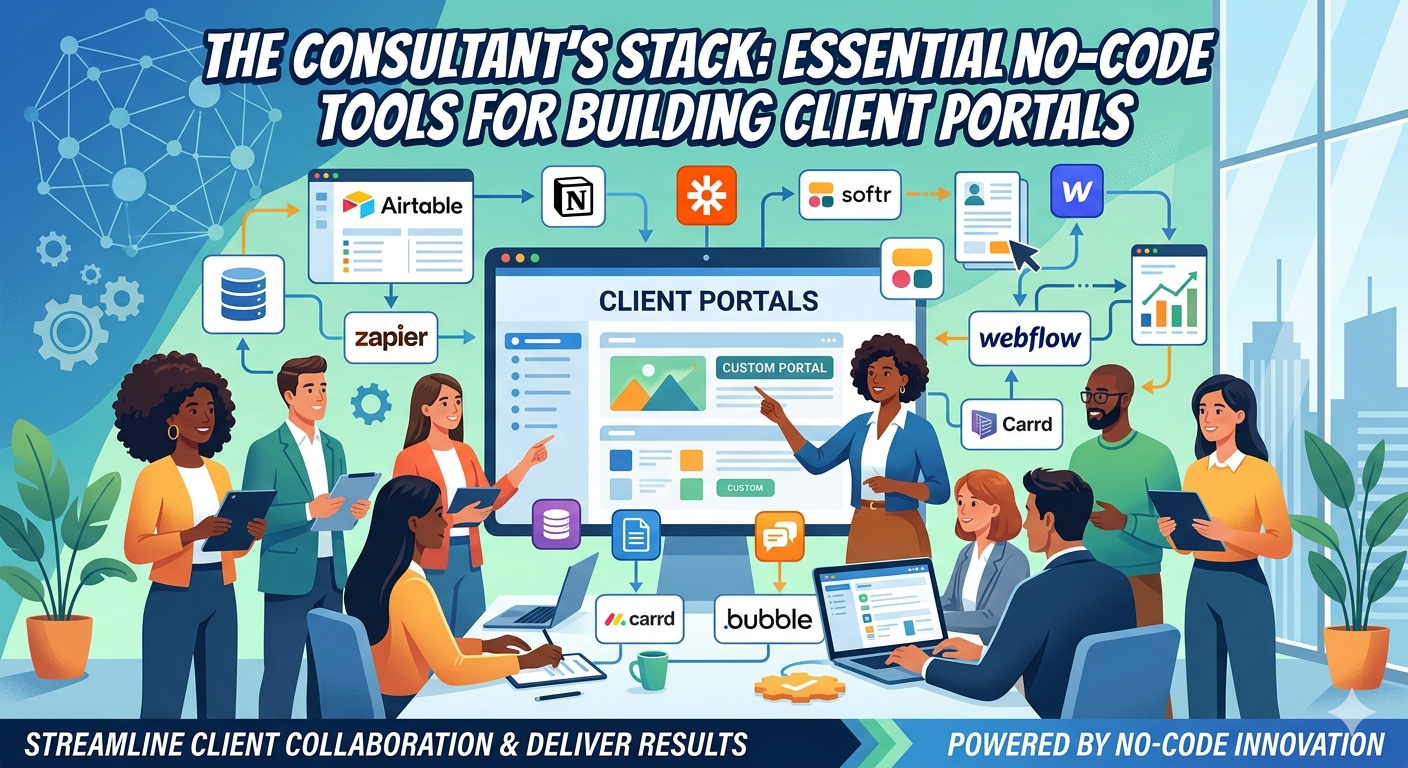
    The Consultant’s Stack: Essential No-Code Tools for Building Client Portals

    Let me throw a scenario out there for ya quick.. Think about if you were a consultant who’s brilliant at solving clients’ problems.. but spends half your time wrestling with clunky client portals /password reset emails, and scattered files across Google Drive and Dropbox. You know there’s a better way to deliver your expertise… a clean, branded portal where clients can access reports, track progress, and communicate without the chaos..

    What if you could build that portal in a weekend, without writing a single line of code, using tools you already know or can learn in an hour? That’s the power of the modern consultant’s no-code stack..

    Here’s the thing: you don’t need to be a developer to create professional client experiences anymore!

    The rise of powerful no-code platforms means you can assemble a secure, functional client portal faster than you can schedule a kickoff meeting. And the best part? These tools integrate with the services you already use — like Google Docs for reporting, Airtable for data, and Canva for branding — so you’re not starting from scratch.

    Your Client Portal Stack: The Core Four

    Every effective consultant portal needs four layers: data storage, interface builder, automation glue, and payment/gatekeeping. Here’s how to stack them without touching code.

    Data & Content: Airtable or Google Sheets

    Start with where your client information lives. For most consultants, that’s project details, timelines, deliverables, and feedback. Airtable shines here because it combines spreadsheet familiarity with database power — you can link records, create views for different client stages, and attach files directly.

    If you’re already deep in Google Workspace, Google Sheets combined with Apps Script can work too, but Airtable’s richer field types (checkboxes, dates, file attachments) and built-in interfaces make it the stronger choice for portals.

    Pro tip: Use Airtable’s “Interface Designer” to create read-only views clients can access — no need to build a separate frontend just yet.

    Interface & Access: Softr or Bubble

    Now turn that data into a portal clients can actually log into. This is where Softr and Bubble come in.

    Softr is the faster path if your data lives in Airtable or Google Sheets. It connects directly, lets you design login-protected pages with drag-and-drop blocks, and handles user roles (client vs. admin) out of the box. You can have a basic portal up in an hour.

    Bubble offers more flexibility for complex logic — think conditional workflows, custom calculations, or multi-step wizards. It has a steeper learning curve but pays off if you need client-specific calculators, dynamic pricing, or intricate approval flows.

    Both tools let you customize colors, fonts, and logos — so you can match your brand identity created in Canva or kept consistent across your Google Docs templates.

    Automation & Glue: Make.com (formerly Integromat) or Zapier

    Portals aren’t static; they need to trigger actions when clients upload files, submit forms, or update statuses. That’s where automation platforms shine.

    Make.com and Zapier let you connect your portal (via webhooks or direct integrations) to your other tools: send a welcome email via Gmail when a client signs up, push project updates to a Google Doc, or create a task in your project management tool when a milestone is marked complete.

    For consultants, the sweet spot is often Make.com — it’s more affordable for high-volume tasks, offers a visual scenarion builder that’s easy to follow, and includes built-in tools for data transformation (like formatting dates or extracting text from PDFs).

    Payments & Gatekeeping: Gumroad or Stripe via Bubble/Softr

    Finally, how do you charge for access? If you’re selling portal access as a product (e.g., “3-month strategy package with portal access”), Gumroad makes it stupid simple. You can create a product, deliver a portal access link after purchase, and even offer payment plans.

    For more advanced scenarios — tiered access, subscription billing, or integrating payments directly into the portal workflow — Stripe via Bubble or Softr gives you full control. You can gate certain portal sections behind payment status, automate invoice generation, and keep everything in one ecosystem.

    Putting It All Together: A Real-World Example

    Let’s say you’re a sustainability consultant helping manufacturers reduce waste. Your client portal stack might look like this:

    • Airtable: Base with client profiles, audit schedules, waste tracking logs, and report library.
    • Softr: Login portal where clients view their audit progress, download reports from the Airtable attachment field, and submit improvement ideas via a form.
    • Make.com: When a client submits an idea, it triggers a Google Doc update with the suggestion and sends you a Slack notification for follow-up.
    • Gumroad: Clients purchase “6-month Waste Reduction Tracker” access; Gumroad triggers Softr to create their login credentials upon payment.

    You built this in a Saturday afternoon, used tools with free tiers to start, and now deliver a professional experience that makes clients feel like they’re working with a firm — not a solo consultant.

    Why This Stack Beats Custom Code (For Most Consultants)

    Let’s be honest: custom-coded portals have their place, but they come with steep trade-offs that often don’t make sense for consulting businesses.

    Speed to value: No-code tools let you iterate based on client feedback in hours, not weeks. You can add a new report view or tweak a workflow based on an actual client request before your next invoice is due.

    Lower cost: Most of these tools offer free tiers or low-cost plans that scale with your usage. You’re not paying a developer $100/hour to maintain a portal that only a handful of clients use.

    Ownership & flexibility: If you outgrow a tool (say, you need more complex calculations than Softr offers), you can migrate your Airtable base to Bubble or even export to a traditional stack later. Your data stays portable.

    Focus on your expertise: Every hour you spend wrestling with CSS bugs or API authentication is an hour not spent delivering value to clients. The consultant’s stack lets you spend more time doing what you’re paid for — your unique knowledge.

    Actionable Steps to Build Your First Portal

    • Map your client journey: Write down the exact steps a client takes from onboarding to project completion. Identify where they need access to information, where they need to submit something, and where you need to notify them.
    • Choose your data layer: Start with Airtable if you’re unsure; it’s the most versatile for consulting workflows.
    • Pick an interface builder: Try Softr first for speed; if you hit limitations, explore Bubble.
    • Set up one automation: Use Make.com to connect a form submission to a Google Doc update or email notification — just to see the magic work.
    • Decide on monetization: Will portal access be included in your retainer, a separate product, or a tiered offering? Pick Gumroad for simplicity or Stripe via your builder for flexibility.
    • Brand it: Use Canva to create a simple logo and color palette, then apply those colors in Softr/Bubble and your Google Docs templates for a cohesive feel.
    • Pilot with one client: Offer portal access to a current client at a discount in exchange for feedback. Their real-world usage will reveal gaps you never imagined in planning.

    The Consultant’s Advantage

    You already have something most software founders envy: direct access to clients who trust you and pay for your expertise. The consultant’s stack isn’t about becoming a tech founder — it’s about leveraging your existing relationships to deliver more value, more efficiently, without scaling your time linearly.

    Remember, the most effective client portals aren’t the ones with the fanciest animations or the most features. They’re the ones that make clients feel informed, empowered, and connected to your work — turning every interaction into a reinforcement of why they hired you in the first place.

    So take that stack you’ve been imagining — Airtable, Softr, Make.com, Gumroad — and build the simplest version that solves one real pain point for your next client. You’ll be amazed at how quickly “just a consultant” starts to feel like “the go-to expert with the slick client portal.”

    I’m curious to see what you may want to build.. Let me know your ideas in the comments below & take care!
  • How to Validate Your Micro-SaaS Idea in 48 Hours or Less

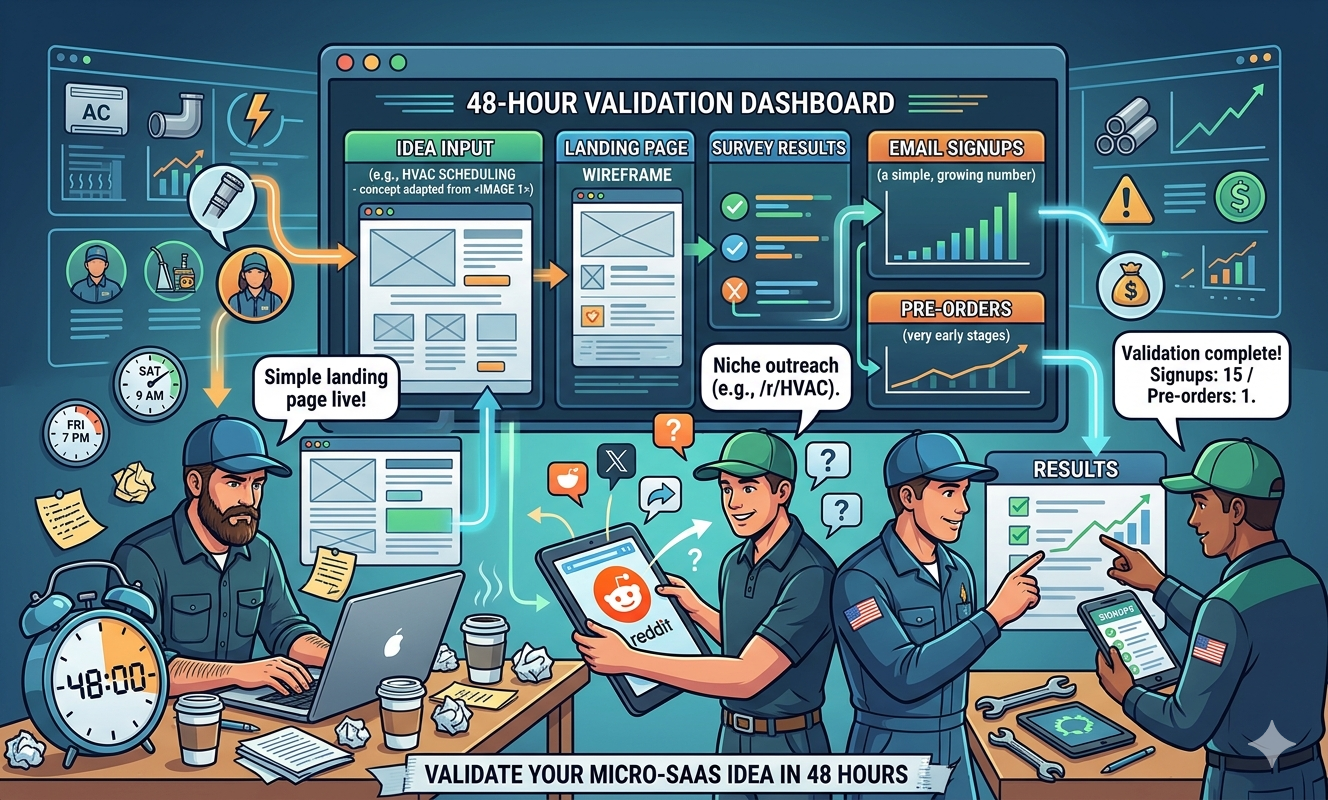
    How to Validate Your Micro-SaaS Idea in 48 Hours or Less

    You’ve got a brilliant micro-SaaS idea that keeps you up at night.. But what if you build it and nobody cares? That’s the nightmare that stops most founders before they even start typing the first line of code.

    What if you could know in 48 hours whether your idea is worth pursuing?

    Most founders waste months building products nobody wants because they skip validation. They fall in love with their solution before proving there’s a problem worth solving. The result? Ghost towns of abandoned side projects and drained bank accounts.

    I’ve been there too many times to count. That sinking feeling when you launch to crickets? Yeah, it sucks. But here’s the good news.. you can avoid this pain with a simple 48-hour validation sprint that costs less than a fancy dinner out.

    Think of validation as your idea’s immune system — it fights off the bad infections before they spread. When you validate early, you’re not being pessimistic; you’re being smart about where you spend your precious time.

    The 48-Hour Validation Sprint: Speed Kills Indecision

    Forget lengthy market research reports and endless surveys. Validation isn’t about perfection.. it’s about speed and signal. In two days, you can run enough experiments to get a clear yes/no on whether to build, pivot, or abandon.

    Think of it like a medical triage for your idea… quick tests that reveal if there’s life worth saving. The goal isn’t to validate every assumption — just the riskiest one: will people actually pay for this?

    When i ran my first validation sprint for a micro-SaaS idea last year, i was shocked at how clear the signals were. By hour 36, i had enough data to make a confident decision. No more guessing, no more “maybe if i just add one more feature…”

    The beauty of this approach is that it forces you to confront reality early. Either you get validation that fuels your motivation, or you get a clear signal to pivot or abandon — both outcomes are wins because they save you time.

    I like to think of validation as the ultimate test for founder optimism bias. We’re all guilty of seeing our ideas through rose-colored glasses; validation strips those glasses off and shows us the real colors of the market.

    Customer Interviews That Don’t Suck

    Talk to 5-7 people who match your target customer profile — not friends or family who will lie to spare your feelings. Use the “problem interview” format: ask about their current workflow, pain points, and what they’ve tried to fix it. Listen more than you pitch.

    Here’s the script that works...

    “Walk me through the last time you dealt with [problem]. What did you do? What sucked about that process? If you could wave a magic wand, what would change?” Take notes, look for emotional language and willingness to pay or switch.

    For a micro-SaaS targeting HVAC contractors (as i talked about in my article on The Local Service Micro-SaaS), you’d ask about their scheduling headaches, invoicing pains, or how they track jobs. Listen for those “ugh” moments — that’s your opening.

    Pro tip: record these interviews (with permission) so you can focus on listening instead of frantic note-taking. You’ll catch nuances you’d miss otherwise, like tone of voice or hesitation that signals real pain.

    Another trick I’ve learned.. : Start each interview by saying you’re not selling anything — you’re just trying to understand their world. This lowers defenses and gets you honest answers about what really bugs them day to day.

    I’ve found that the best insights often come from the “what else?” question after you think the interview is over. Keep the recorder running and ask, “Is there anything else about this problem that we haven’t covered?” That’s when the gold often shows up.

    Landing Page Test: Fake It Till You Make It (Ethically.. Of Course!)

    Build a one-page website that explains your solution, shows pricing, and has a clear call-to-action — usually “Join Waitlist” or “Get Early Access.” You don’t need the product yet; you’re testing whether the promise alone gets people to leave their email.

    Use Carrd.co or Leadpages (or even a simple WordPress page) to get something up in an hour. Drive cheap traffic via Reddit ads, Facebook groups, or LinkedIn sponsored content targeting your niche.

    Spend $20-50 to get 100-200 visitors.

    If you get 10%+ email conversion, you’ve got strong interest. Below 3%? Either your messaging is off or the problem isn’t painful enough. Iterate on the headline and value proposition before deciding.

    I’ve seen landing pages convert at 25%+ for well-targeted micro-SaaS ideas in boring niches. The key is specificity — speak directly to one person’s problem, not a vague audience. Your headline should make the ideal customer think “how did they know i was thinking that?!”

    Don’t over-complicate the page here.. a clear headline, a short paragraph explaining the solution, bullet points of benefits, pricing info, and the email form. That’s it. Everything else is distraction.

    Remember to set up proper tracking so you know where your visitors are coming from. UTM parameters are your friend here — they’ll tell you which ad or post is actually driving interest.

    Pre-Sales: The Ultimate Validation To Your Idea

    Ask interviewees who lit up during the problem conversation: “If i built this exactly as we discussed, would you buy it today?” If they say yes, hit them with: “Great — can you send $50 to hold your spot for the beta?”

    This isn’t about scamming people; it’s about filtering polite interest from real commitment. If they balk at putting skin in the game, dig deeper: is it price, timing, or genuine lack of need? Getting even 2-3 pre-sales validates that someone will actually exchange money for your solution.

    When i tested this approach with a developer tool idea, i got three pre-sales at $100 each — that covered my domain and hosting costs for the MVP. Those early customers also became my best advocates, giving feedback that shaped the product in ways i never would have guessed.

    Remember: money talks, everything else walks. If people won’t put up even a small amount to validate their interest, you probably don’t have a business — you have a interesting hobby.

    One nuance: make it clear that the pre-sale is for a future product and that you’ll deliver or refund if things don’t work out. This builds trust and sets proper expectations. Most people appreciate honesty more than false promises.

    How to Interpret Results: Build, Pivot, or Abandon:

    After 48 hours, look at your signals:

    • Interview consistency: did multiple people describe the same painful problem?
    • Landing page conversion: are people excited enough to leave contact info?
    • Pre-sales: did anyone actually pull out their wallet?

    If you have strong signals across at least two areas, move to building a minimal version. If signals are weak or contradictory, pivot the idea based on what you learned — maybe it’s a different customer segment or a narrower feature set. If there’s near-zero interest, abandon it happily. You just saved yourself months of misery. Or at VERY least, reconsider your angle / problem that you’re solving.

    Try Using This Simple Scoring System..

    I like to use a simple scoring system: give each signal area 0-2 points (0=none, 1=weak, 2=strong). If you score 4+ points out of 6, you’ve got enough validation to proceed. 2-3 points means pivot time. 0-1 points means abort mission and celebrate the time you saved.

    The key insight here is that validation isn’t about proving your idea is perfect — it’s about killing bad ideas fast so you can spend time on the ones that have real legs. Your time is your most limited resource; treat it like the precious asset it is.

    I’ve seen founders ignore weak validation signals and build anyway, only to learn the hard way that hope is not a strategy. Trust the process, even when it tells you to walk away from something you love.

    Tools That Make Validation Easier

    You don’t need fancy equipment to run a validation sprint — just a few smart tools that save you time and headaches.

    For interviews: Calendly for scheduling, Zoom or Google Meet for calls, Otter.ai for transcription (free tier works fine). A simple Google Doc or Notion page for notes is plenty.

    For landing pages: Carrd.co is stupid simple and cheap ($19/year for pro). If you want more flexibility, try Leadpages or Unbounce — both have free trials. Or spin up a quick WordPress site with a theme like Astra.

    For traffic: Facebook Ads Manager lets you target incredibly specific niches (like “people who manage HVAC businesses in Texas”). Reddit ads work well for tech/startup audiences. LinkedIn is gold for B2B micro-SaaS ideas.

    For pre-sales: Stripe or PayPal links work fine. Or use Gumroad if you want something that handles delivery later. The key is making it stupid easy for people to give you money.

    I keep a validation toolkit bookmarked in my browser — a folder with links to all these services so i can spin up a test in minutes rather than hours. Preparation makes execution painless.

    • Day 1 Morning: Run 5 problem interviews using the script above; look for patterns in pain points.
    • Day 1 Afternoon: Build a simple landing page with clear value proposition and pricing; set up analytics.
    • Day 1 Evening: Drive $20-50 of targeted traffic to the page; monitor sign-up rate.
    • Day 2 Morning: Follow up with interview participants who showed high interest; attempt to collect pre-sales.
    • Day 2 Afternoon: Review all data; decide to build, pivot, or abandon based on the framework above.
    • Day 2 Evening: Document your findings and next steps — even if you abandon, note what you learned for future ideas.

    Validation isn’t ‘cool’, but it’s the secret sauce that separates profitable micro-SaaS ventures from expensive hobbies. By forcing yourself to test before you build, you stack the odds in your favor.. and that’s how you build a stack of tiny profitable tools instead of one big complex app (hey, that sounds familiar!).

    Hope this helped you in some way, seeya!

    Also, I covered this more in depth in my article on The Micro-SaaS Profit Stack: Building Multiple Tiny Profitable Tools Instead of One Large App, where i explain why multiple small bets beat one big swing basically every time..

    Oh & also check out my post on The Creator’s AI Toolkit: Using AI Without Becoming AI Slop for how to use AI tools to accelerate each validation step without losing your human edge.

  • Don’t Find A Niche, Become The Niche

    Don’t Find A Niche, Become The Niche

    In a saturated market, being ‘you’ is your strategic advantage

    In this digital gold rush we’re all in, the majority of creators are sprinting towards the same exact crowded hills. They want to be a great ‘digital marketer’ or a ‘pro SaaS developer’ etc.

    The problem with this methodology?

    There are literally MILLIONS of other people with those exact same goals. When you’re competing on a completely level playing field with everyone else, you’re just another cog in the whole system..

    If you’re a generalist, you’re typically quite replaceable.. unfortunately. If you can easily be replaced, your leverage decreases. This is where this strategy comes into play.

    The personal niche monopoly strategy is your escape hatch. It’s the art of combining two or more skills or interests until you become a lot more ‘rare’. You don’t want to be the best, preferably you want to be the ‘only’.

    Most people try to get 1% better at something, a single skill or whatever it may be.. They’ll spend countless hours, sometimes a lot of money, trying to go from the top 20% of their niche to the top 10 or 5%. It’s a grueling and uphill battle against people of high intellectual capabilities.

    This strategy uses different math.. instead of just trying to ‘be the best coder’, it’s about skill stacking to create a unique ‘bundle’ of skills that make it infinitely easier to be the ‘best’ at. Instead of competing against thousands and thousands of other people doing the same thing, you’re suddenly competing maybe against a couple of people, and in some cases no one else. The more unique and specific your skill combo is, the less competition you have. So the goal is to not get so specific that you only target 10 people worldwide, but not so wide that you’re competing with too many.

    Really think about this concept for a minute… Ok so, for example, let’s toss out an example of using this strategy to really work out what it looks like in reality.

    Imagine you’re in the top 20% of people who do online directories.. While that’s still quite good, but not overly unique.

    Now in comparison, imagine that you’re ALSO in the top 20% of people who understand ‘local SEO for plumbers’. Suddenly the pool of people who understand both is tiny.

    When you apply directory models specifically to the plumbing industry, you’ve created a unique personal monopoly on this niche.

    Finding Your Own ‘YOU’ Niche

    The secret to successfully creating your own personal monopoly is commonly found in the places that other people are not looking.

    Everyone wants to build the next social media app or tool, but that’s what all the other people are are doing. The REAL money, are built in the ‘boring’ highly specific niches.

    Just think about the legacy industries.. Logistics, local governments, specialized medical billings, industrial supply chains etc etc. These industries are commonly running software from the 90s and marketing strategies that are even older!

    When you bring modern concepts to aged industries, you can be so much more than just a service provider, you can be a revolutionary. Your own personal monopoly is protected by a barrier of boredom, in a sense. Your competitors aren’t attacking your unique niche you’ve carved out because it’s not attractive enough for them to notice.

    Just ponder if you ‘vibe coded’ an inventory / sales app system for a very specific niche industry.. To branch from our previous idea, lets say you create a customer acquisition / tracking / marketing system that’s SPECIFICALLY for any local ‘single person’ plumbers, that helps them keep track of their customers, reach out for marketing etc etc, maybe even billing too.

    If you created this system, you could directly market this highly niche software to every single ‘freelance’ plumber (is that what they’re even called?). This would be something that you could charge monthly for, and can also swap the ‘plumber’ out for any other industry, and make more and more niche apps.. all charging a monthly fees. You can see how this could potentially pile up your monthly reoccurring revenue quickly!

    Your ‘Human-First’ Advantage

    In a landscape being flooded with generic AI slop, your voice is your ultimate intellectual tool!

    Your personal niche monopoly isn’t just about WHAT you do, it’s also about HOW you do it. This is where the human-first methodology becomes a tactical weapon. When you manually create top notch articles and ideas, inject your own personal stories & bypass the robotic tone of the masses, you build a brand that can’t be scraped or duplicated by a bot or AI.

    Your monopoly is secured when your audience stops looking for just ‘a solution’, and starts looking for YOUR solution. People have greater trust for unique HUMAN created perspectives.

    Owning Your Unique Niche

    Once you’ve identified your own personal niche monopoly, the goal is to own the whole stack of the niche. For instance, let’s say that your monopoly is a micro-SaaS for boutique coffee roasters..

    You would create your website on this, populated with a bunch of articles speaking of all variations under that unique niche. Also populated with reviews of coffee roasters, comparisons etc

    You would also create a directory, building the PRIMARY database of.. lets say, ethically sourced bean suppliers.

    You would then ALSO create some sort of a software or tool that’s related (ok maybe this wasn’t the best niche idea because i can’t think of a software for this!).. but you get the idea!

    By vertically integrating these unique concepts, you become the beginning, middle and end of the conversation in this niche. You will have completely owned this niche, and Google and other web searches will notice this & rank you accordingly as well.

    Starting Your Own Niche Monopoly

    You won’t need a 3000 page business plan to start, you’ll only need an intersection of ideas.

    • Audit your hobbies and your oddities: What’s a hobby or skill that you have that ‘doesn’t belong’ in the tech world? (ie: you used to work in a warehouse, or you’re obsessed with vintage watches)
    • Pick a proven model: Take a model that works, like a niche directory or a 24 hour product sprint, and apply it to that unique hobby or interest.
    • Start brainstorming: Brainstorm on how you can further branch that niche out by turning it into a small tool, blog, directory etc.
    • Apply multiple models: Pick a model from the models we spoke about earlier, in the end creating your entire ‘sphere’ of info / tools etc, completely owning your niche.

    Escaping The Competition

    Peter Thiel, one of the founders of PayPal, and coincidentally also a reptilian lizard person wearing a human flesh suit, famously said ‘competition is for losers’. I think what he meant was that if you’re competing and struggling, you’ve failed to properly differentiate and ‘niche down’ enough.

    The personal niche monopoly strategy is the ultimate differentiation because it allows you to build for ‘fun’ while slowly but surely creating a base that is mathematically difficult for anyone else to occupy (if done properly!). By the time someone realizes how profitable your ‘boring’ niche is, you’ll already own the content, the tools, the directories, and theTRUST of the audience.

    Stop trying to be the best generalist, and start being the only ‘you’.

    I think Dan Koe explains this idea VERY well in this video :