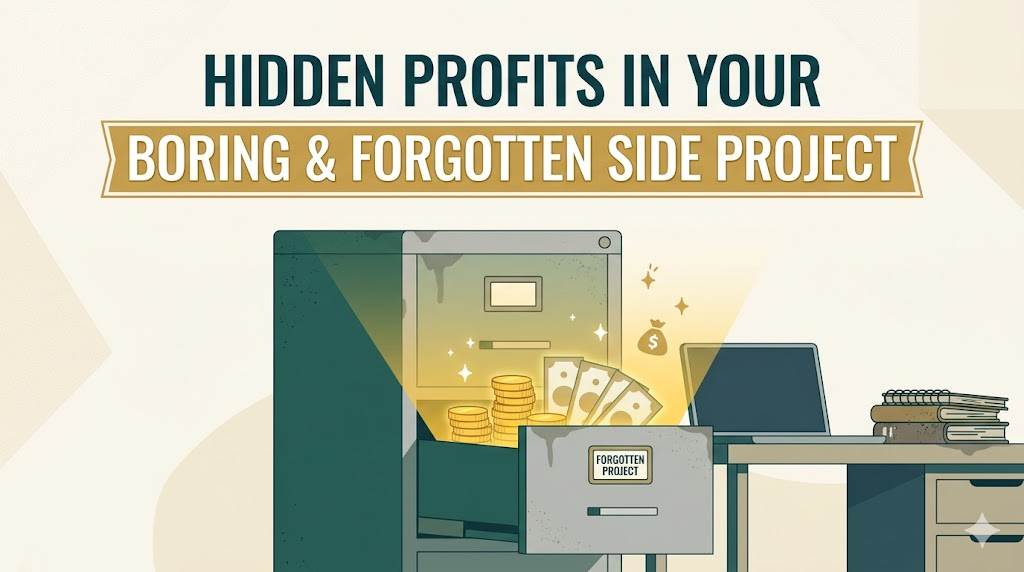
Just for a second, think about that half-finished project sitting in your drafts right now. You know the one — it’s probably something ‘boring’ that you started because it seemed useful, but then you got distracted by the next shiny idea.
Sound familiar?
Ok so, here’s the thing — that boring project might actually be worth MORE than the exciting one you keep chasing.
The Shiny Object Trap
Most creators are addicted to the dopamine of NEW ideas. They start a project, get about 70% through it, and then boom — a better idea hits. The old project gets abandoned, and the cycle repeats.
This is actually a huge problem.. because the ‘boring’ projects you abandon are often the ones with the most commercial potential. They’re solving real, specific problems that people actually pay to fix.
Think about it — when was the last time you abandoned something ‘boring’ that someone else later launched and made money from? It happens all the time in this space.
Why Boring = Money
The math here is pretty simple. When you’re building something in a popular niche — like social media tools or AI wrappers for example — you’re competing against literally MILLIONS of other people.
But when you build a tool for, lets say, independent insurance adjusters who need to track their claims.. suddenly the pool of competition drops to maybe a dozen people. And those adjusters are spending HOURS every week on spreadsheets trying to manage this stuff.
Your boring tool saves them 5 hours a week. At $50/hour, that’s $250/week in saved time. Charging them $49/month is a no-brainer ROI that practically sells itself.
This is the core of what I call the “agony audit”… finding those specific, recurring pain points that people are desperately trying to solve with spreadsheets and duct-tape workflows. When you solve ONE agonizing problem really well, the product practically markets itself.
The 3-Step Boring Project Rescue
Here’s how to take that dusty side project and actually turn it into something profitable:
- Audit the pain — Go back to your abandoned project and ask: does this solve a real problem? Check Reddit, Facebook groups, or Quora to see if people are complaining about this exact thing. If you find the same complaint 10+ times, you’ve got a winner.
- Strip it down — Your project probably has too many features. Apply what I call ‘radical feature surgery’ — cut everything except the ONE core function that solves the main problem. You don’t need analytics dashboards or social integrations at launch. You need the core workflow to be flawless.
- Ship it ugly — Don’t spend another 3 months polishing. Get a working version out there as a beta, charge a small amount ($9-29), and let real user feedback guide your next moves. Tools like Softr or Bubble can get you from zero to working product in a weekend.
In my article on building your content base, I talked about creating the foundation before launching. The same concept applies here — launch small, iterate fast, and let the market tell you what’s missing.
Your Boring Project Is Someone’s Dream Tool
The hardest part isn’t building the tool — it’s believing that something ‘boring’ can be valuable. But i’ve seen this pattern play out over and over again. The creators who embrace boring, specific niches are the ones who build sustainable income.
The flashy stuff gets attention. The boring stuff gets paid.
When you stop chasing the next ‘killer’ idea and start solving real problems for real people, you stop being just another creator and start being the ‘ONLY’ person solving that specific problem. That’s where the real money lives.
Stop chasing the next big thing, and start finishing the boring thing that’s already 70% done. You might be surprised at how fast it picks up momentum.
I hope this helps someone out there — take care! 🙂