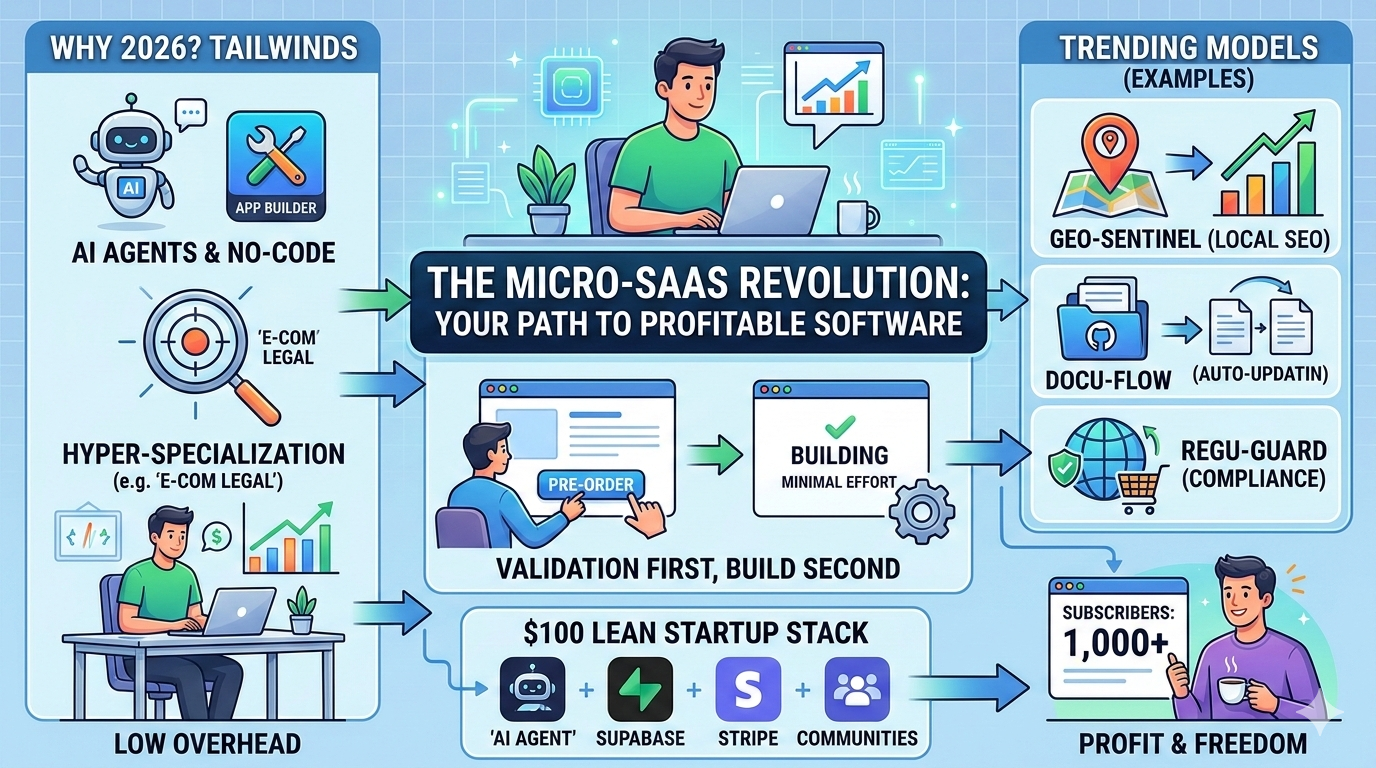
It’s a new year! Back in ‘my’ day, a couple years ago, building your own SaaS product meant typically at least a handful of people building together (minus a few exceptions of course!). At least months of development, testing, bug fixes, market-fit etc. Tens of thousands of dollars, the list goes on..
But today, in 2026, that barrier to entry has basically vanished. While the foundations haven’t changed much, today ANYONE can ‘vibe code’ their way to a working prototpe software within hours – or days,depending on the complexity.
The global SaaS market is growing to 300+ billion annually, and the real winners aren’t the ones trying to be the next slack or photoshop.. they’re individuals building highly specific, niched down software that solve a very specific problem to a very specific customer.
Why 2026 is the year of micro-SaaS domination
The software landscape has shifted due to a couple of primary reasons that make this the absolute most profitable time in historty to be creating your own products.
The death of the dev team
With agentic AI (think like Abacus deep agent, or git hub ghost editors), a single person can now generate a full stack full on application. Complete with user authentication, log in, databases for remembering and recalling user data, and even Stripe integration, all in a weekend.
The vibe coding ‘epidemic’ has all basic functionality built in and easy to deploy with some prompts and clicks. While this has created a plethora of similar looking apps, the people that branch out and are able to customize and create unique looking, niched-down specific applications to a specific problem or pain point, are the ones that are absolutely KILLING it lately.
Hyper specialization
General tools are suffering from feature bloat, while users are now willing to pay 2 or 3 times the price for a tool that solves ONE specific, high stake problem for one specific industry.
High margins
Micro-SaaS companies are typically generating 70-85% profit margins (sometimes even higher!) by keeping teams small, or non-existent, leveraging AI for customer support and dev work, and marketing.. Making the overhead almost ZERO.
OK so, what’s the RIGHT strategy for 2026 when building your own SaaS software / solution?
Product-fit / and idea validation first, then develop after. Seems simple, but too many skip or reverse this – having an idea, developing everything to perfection, and THEN trying to see if theres demand for it.
If you start out by writing code, you’ve already failed. Success these days follows a very specific pipeline:
- Identify a particular pain point: Pick a specific industry or really whatever subject you’re interested in potentially making a software for. Start browing posts on social media, facebook etc about this subject, and take note of particular problems that people are talking about more than once. IE: You see posts in a dog training facebook group about ‘how to stop my dog pulling when on their leash’.. or something simple like that.
- Validation: After making a small list of the various pains or problems that real users have in a particular subject, that seem to keep coming up, create a simple landing page but instead of a ‘buy now’ button, you’ll have a ‘pre-order’ or ‘join beta access’ or something along those lines, as your call to action. If people will pay, or sign up, for a product solving this specific solution, you may have a potential software, or in this case e-Book guide, that you could create & sell to them.
- Variations of price: See how much people are willing to pay for your micro-SaaS solution. try various price points to get a feel for the rough amount you may want to charge for this.
- Overhead view: After finding specific pain points, validating that people want and will pay for a solution, look at everything you’ve compiled up until now & have an honest thought about if you could see a specific solution working for this instance. Also see if theres ENOUGH people to justify a product for that specific problem, and if not, then start compiling more closely related problems to join together for a more thorough solution to a handful of similar pain points.
- Start building! : Using various AI vibe coding solutions, or if you’re a developer, start creating your SaaS software. Ensure that you focus on the specific features and solutions that people actually use & want.. Sometimes simplicity is best.
Here’s some trending micro SaaS ideas to get you brainstorming!
| Model | The Pain Point | The 2026 “Moat” | Pricing Strategy |
| Geo-Sentinel (Local SEO) | Local businesses losing to neighbors in the “Map Pack.” | Direct integration with Google Business Profile & local news APIs. | $49/mo per location. |
| Docu-Flow (DevDocs) | Documentation dying as code moves faster than humans. | Listens to GitHub PRs and auto-updates ReadMe in brand voice. | $19/mo per repository. |
| Regu-Guard (E-com) | Shopify sellers accidentally breaking EU/California shipping laws. | Proprietary “Legal Logic” layer that guarantees compliance. | $29/mo + usage fees. |
| Synth-Scale (Data) | Privacy laws (GDPR) making it illegal to test with real user data. | Agentic AI that generates statistically accurate “fake” data. | $0.05 per k rows. |
| Vibe-Check (Influencer) | Brands wasting money on influencers with “bot” comments. | Sentiment analysis that filters “Buying Intent” from bot noise. | Credits-based ($99/10 audits). |
The $100 SaaS Startup Stack
You dont need VC investments anymore to start your own copmany or solution. Now you can simply use AI for foundational development of your product.
For development: Vibe code your way to success using AI coding agents such as Lovable or Abacus AI.
For the backend / database parts: You can use Supabase!
For payments: Stripe or even just paypal for a more simple version will work.
Distribution and marketing: Niche communities on FB, Reddit, Discord, LinkedIn, etc are a great place to either start promoting, or to find your initial pain points to start from.
Lets recap everything
These days, in 2026, niche-specific solutions can be your superpower! The market is tired of all of these all in one platforms that can do everything but do it poorly. They want highly specialized solutions that does the specific thing they need, and do it VERY well. If you can save a specific type of person one hour of manual work a day, you dont just have a tool, you have a potential 6-figure business model.
Comments
2 responses to “The Micro-SaaS Revolution – Building Profitable Software in 2026”
Vibe coding just makes a bunch of copy cat programs that all look alike
This was actually helpful, I appreciate it thank you.