Price is more than just a number – lets dive into why and how to get people to click your buy button
We all like to think we’re rational, and fully in control of all of our decisions. We believe that when we’re considering buying something, whether cheap or expensive, that we are fully calculating the importance and utility.
” Guess what.. we’re wrong! Well not completely, but more than one may initially think! “
If you’re selling digital products, SaaS subscriptions, or high ticket items, understanding this fundamental truth is the difference between struggling for traction and scaling without effort. The most dangerous assumption you could possibly make is that your customers are buying your product because of merely it’s features. While features ARE essentially of course, there’s much more going on behind the scenes.
They aren’t buying solely on features, they’re buying on how the product, and specifically the price you’ve set, makes them FEEL. There’s a subconcious weighing of scales, comparing you to your competitions prices and vibes.
Price is not merely a calculation of your overall costs + some margin. Price is a SIGNAL, it’s communication.. it’s psychology honestly. This is what markets call behavioral economics – and today we’re going to intimitely dismantle why we make the decisions we do, and how you can ethically apply these triggers to your own offers!
The myth of rational choice
In classical economics, consumers are described as Homo Economicus (crude, I know!). Infinitely rational buyers with perfect information who always absolutely maximize their purcase to 100% max.
If that were actually true, luxury brands would vanish overnight. No would work EVER buy a $300 cotton shirt. We’d all drive the most fuel efficient vehicles, eat the most perfectly balanced diets – and only buy items when they’re on markdown.
Truth of the matter is – take just about ANY given course or product – a huge percent of people that buy anything, literally end up NOT using it.. As crazy as that may sound!
Behavioral economist Dan Ariely has proven the opposite. That we are predictable, repeatedly, and systematically irrational. Our brains are designed to make and take shortcuts – constantly! When we see a number, we dont process it in a vacuum, we process it relative to our mood, other numbers, and past experiences.
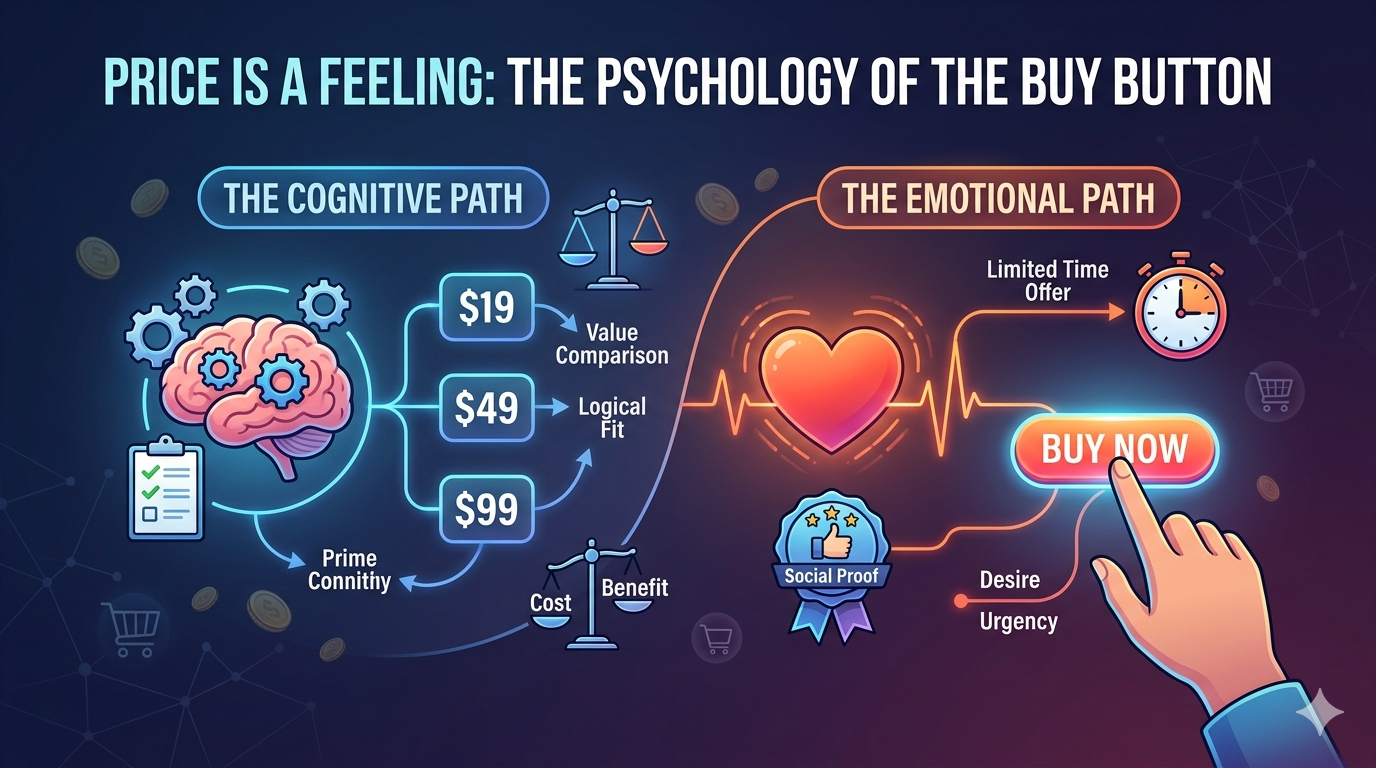
When we’re considering clicking the ‘buy’ button & heading to the checkout page for an item, our brain is processing at least two competing signals.
- The cognitive / logical path: This path is slow and energy intensive, it uses working memory to compare features, analyze data, and question the necessity of the purchase. Your brain wants to know “Is this the best price?”
- The emotional / FEELING path: Now this path is instant and intuitive. It reacts to desire, status, FOMO, and relief. It wants to know “Do I need to solve this problem right now?”
The ‘secret’ to conversion maximization is not the overriding of the logical path, but rather to give the emotional path enough fuel to win the argument quickly.
OK lets get to the goodies –>
Here are SEVEN specific psychological triggers that can help with activating the emotional pathway to purchasing.
1. The Anchoring Effect
The brain is a contextual machine. When we encounter a number for the first time (the price in this case), it becomes anchored in our mind. All subsequent info is judged relative to that anchor.
Trigger: Placing your highest priced option before any others, or displaying a much higher ‘regular’ price next to, or before, your discounted ‘sale’ price.
Feeling: Relief, feels like they’re saving money.
Applying: Lets say you sell a 3 tiered product, don’t list them the typical way – like the ‘starter’ tier, ‘pro’, and ‘agency’. Instead simply reverse it. By seeing the highest price first, you’ll find that you’ll make much more of the ‘middle’ plan than the cheapest or most expensive. This alone can produce higher profits.
2. Decoy Pricing
This is one of the most elegant triggers in all of marketing. This relies on the fact that when faced with multiple complex options, we can easily get confused. To effectively break this stalemate, lets look for an easier comparison.
Trigger: In this example, lets say we have three options just like before, but the cheapest plan is BARELY cheaper than the mid-tier, but has substantially less value – making it a no brainer to pick the middle option.
Feeling: “It would be stupid to NOT pick the middle choice!” Clear confidence in picking the most ‘bang for their buck’ option.
Applying : Using Dan Ariely again, he famously tested the Economist magazine subscription model such as this:
- Web-only: $59
- Print-only: $125
- Web & Print: $125
Nobody bought the ‘print-only’ option. So why was it even there? It’s entire existence was to make the last option feel like an irresistible deal! Without it, the brain struggles to compare the first and last. With that middle option, it’s clearly the rational choice.
3.Social Proof
When we’re uncertain, which spending money almost always makes us feel this way, we typically look to others for a ‘real’ opinion on a product. Why do you think that ‘five star ratings’ and testimonials are literally EVERYWHERE. If a bunch of people have already purchased something before you, we assume that it must be a good product that does what it’s suppose to do!
Trigger: Highlighting endorsements, case studies, user counts, or prominently displaying a ‘most popular’ tag on one of your pricing tiers.
Feeling: Safety, being part of the crowd – or popular opinion.
Applying: Your pricing table MUST have a winner in it. If all three options look equally appealing, you create ‘choice overload’. By putting a ‘most popular’ tag on your target tier, you are giving the buyer permission to skip the intensive thought processes of comparing every lined feature. You’re saying ‘trusted by users just like you’.
4. Scarcity and Urgency (FOMO – Fear of Missing Out)
The fear of missing out is a powerful cognitive bias. We feel the pain of losing something about TWICE as intensely as we feel the pleasure of gaining something of equal value! When we perceive that an opportunity is vanishing, we stop analyzing and start acting.
Trigger: Countdown timers, limited spots available warnings, or bonuses that disappear at a specific date.
Feeling: Anxiety and relief.
Applying: Use evergreen countdown imers (a timer that resets for each user) for lead magnets or introductory offers, but use hard deadline timers for major lanches. The signal must be authentic, if the offer truly doesn’t ever end, you lose trust forever.
5. “Rule of 100” and Value Framing
The way you display a discount significantly changes the perception of its value, even if the math is completely identical.
Trigger: Use percentage-based discounts for prices under $100. Use absolute dollar-value discounts for prices over $100.
Feeling: Getting the best deal possible, saving money.
Applying:
- A $25 ebook discounted to $20 is a $5 savings, which doesn’t sound THAT exciting. But if you frame the value differently, a 20% savings , this SOUNDS and FEELS like a much better savings!
- A $2,000 course discounted to $1,500 is a 25% savings , sounds pretty good.. But again, framed differently, a $500 savings sounds and feels like a larger amount saved.
Always use the framing that results in the largest number. Your brain latches onto the number itself (20 or 500) before it processes the symbol, a “%” or “$”.
6. Sunk Cost Fallacy (& The Power Of The $1 Trial)
The Sunk Cost Fallacy is when you’ve already spent money on something, even if it’s value ends up not being so great, you end up making yourself use it and keep using it, so you don’t have to feel like you wasted the money on purchasing it.
The same goes for selling on the interwebs. Get them to pay a $1 trial fee – that gets them in and using the product. Once you have one customer, this could lead to upsells (buying more in the program) and eventually more customers.
Trigger: Offer a low-risk “tripwire” product (maybe something like a $9 checklist) or a $1, 7-day full access trial.
Feeling: Invested, and curiosity.
Applying: Once a customer spends just $1, two powerful things happen. First, they have made a commitment, breaking the inertia. Second, they are now “in the ecosystem.” To cancel the trial or walk away, they have to consciously decide that the value you provided was less than $1. Most people will stick around (sunk cost fallacy), allowing you to convert them at the full price later.
7. The Contrast Principle
While Anchoring sets the stage, the Contrast Principle is about how you arrange all the surrounding elements to make the price seem small. This is about framing the investment not against your competitors, but against the alternative costs of the buyer’s current problem.
Trigger: Frame your price against a much larger, quantifiable expense the buyer is already incurring.
Feeling: Rationalization and possibly excitement.
Applying: In my own ‘Anatomy of a Sales Page’ post, I contrast the investment of the course ($997) against the actual costs of failure:
- Hiring a bad copywriter: $5,000+
- Running paid traffic to a page that doesn’t convert: $10,000+
- Six more months of being invisible in your market: Incalculable.
Compared to losing $15,000, investing $997 is no longer a “cost”; it is a sensible insurance policy.
Soo.. In Conclusion: Use These Triggers Responsibility
The triggers outlined here, visualized as complex interplay between the logical brain and the emotions of ‘feeling’, are not magic tricks. They are psychological levers. When you use them responsibly and ethically, they serve to clarify your offer, remove the friction of indecision, and help buyers commit to a solution they actually need.
If your product provides genuine value, it is your responsibility to use every psychological tool available to ensure the brain makes the right connection and clicks ‘BUY.’
I hope you’ve gotten something out of this article, and I hope you have an absolutely wonderful day! Peeeeeacceee.
Comments
One response to “Price Is A FEELING – The Psychology Of Clicking The Buy Button”
tap into unlimited earning potential!