Just for a second, imagine you’re running a small HVAC company in Ohio.. You’ve got 5 trucks, 12 employees, and you’re booked solid 3 weeks out..
But here’s the thing — you’re still trading time for money.. Every service call requires you or one of your techs to be physically present..
What if you could productize some of that expertise?
What if your most valuable knowledge could work for you while you sleep?
Let me explain.. Most local service businesses miss a huge opportunity: they think software is only for Silicon Valley startups or e-commerce brands.. They see quotes for custom software development and immediately shut down — $50K minimum, 6-month timeline, ongoing maintenance costs.. Meanwhile, their competitors in other industries are quietly building tiny software tools that automate their repetitive tasks, generate leads while they sleep, and create entirely new revenue streams..
The problem isn’t that local service businesses can’t benefit from software..
It’s that they’ve been sold the wrong version of it..
They don’t need another bloated CRM or field service management suite that tries to do everything poorly..
They need the opposite — hyper-specific tools that solve ONE painful problem incredibly well..
The Micro-SaaS Mindset Shift
Here’s where most local business owners get it wrong: they think they need to build the next Salesforce or ServiceTitan to compete.. The reality is far more interesting — and profitable..
The most profitable SaaS products aren’t the big fancy ones trying to be everything to everyone.. They’re the boring, hyper-specific tools that solve ONE painful problem for a small group of people who are desperate for a solution..
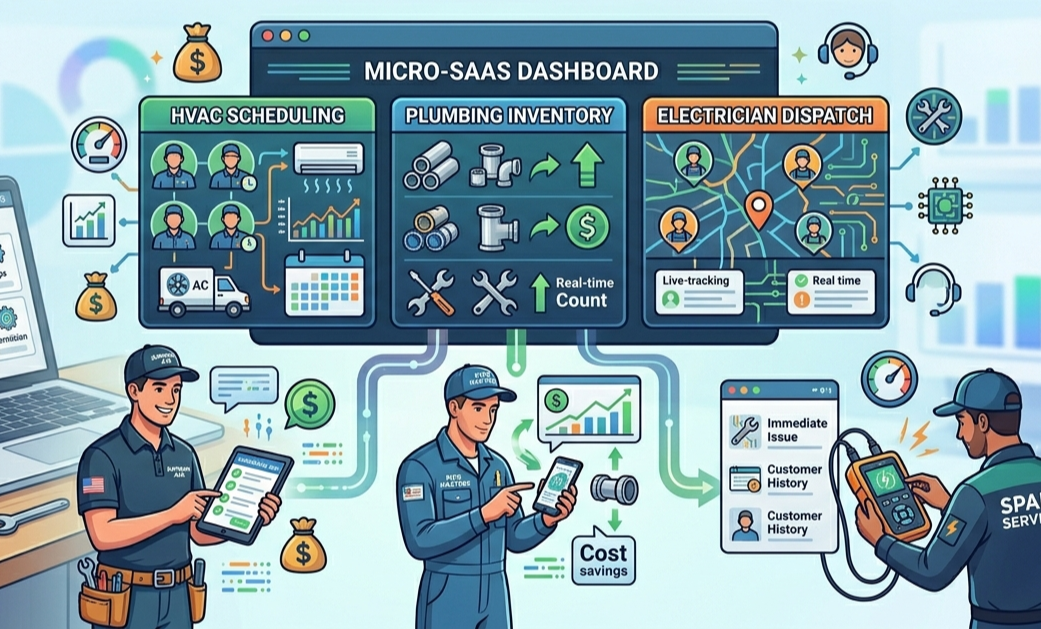
For an HVAC company, that might be:
- A tool that automatically generates permit applications for common installations
- A scheduler that optimizes routes based on parts inventory and technician certifications
- A customer portal that lets homeowners track their maintenance history and schedule annual checkups
- A pricing calculator that instantly generates quotes for ductwork replacements based on square footage and accessibility
These aren’t million-dollar development projects.. With today’s no-code tools (Softr, Bubble, Airtable + Make.com, etc.), you can build and launch these in weekends, not months..
Your Existing Knowledge Is the Product
This is where local service businesses have a massive unfair advantage over tech entrepreneurs..
You don’t need to guess what problems people have — you live them every day.. You know exactly:
- What questions customers ask repeatedly before they’ll book
- Which parts of your process cause the most delays or confusion
- Where your techs waste time on repetitive administrative tasks
- What information customers desperately want but struggle to find
That’s not just experience — that’s your product spec document.. Written in the language of actual pain points, not theoretical use cases..
Let’s say you’ve noticed that 30% of your phone calls are homeowners asking the same 5 questions about whether their old furnace needs replacing or if it can last another winter..
Instead of answering the same questions over and over, what if you had a simple web tool where homeowners could enter their furnace’s age, model, and recent bills, and get an instant recommendation?
That’s not just saving you time — that’s capturing leads 24/7 while positioning yourself as the helpful expert, not the pushy salesman..
The Trust Factor in Local Services
Here’s something tech entrepreneurs rarely understand about local services: trust isn’t built through features or pricing — it’s built through consistency and demonstration of expertise..
When someone’s AC goes out in July, they’re not comparing feature matrices.. They’re looking for the company that seems most likely to fix it right the first time, without upselling unnecessary work or disappearing after the install..
A well-built micro-SaaS tool does something magical for local businesses: it demonstrates expertise before the first phone call ever happens..
Imagine a plumbing company that offers a free drain clog severity assessor online.. Homeowners answer 3 questions about symptoms, what they’ve tried, and how long it’s been going on.. The tool gives them a clear recommendation: try this enzyme treatment, call for hydrojetting, or shut off the water and call emergency now..
That tool isn’t just generating leads — it’s building trust by giving valuable advice for free.. When those leads do call, they’re already pre-qualified and predisposed to listen to your recommendations..
Concrete Example: The Electrician’s Load Calculator
Let’s make this real with a specific example.. Imagine you’re an electrician who specializes in panel upgrades and EV charger installations.. You constantly get calls from homeowners wondering if their 100-amp panel can handle a Level 2 charger, or if they need to upgrade to 200-amps..
Instead of making them wait for a site visit (which you might charge for), what if you had a simple tool on your website where they could:
- Enter their home’s square footage
- List major appliances (AC, oven, dryer, etc.)
- Note whether they have gas or electric heat/stove/water heater
- Add any planned future purchases (hot tub, second AC unit, etc.)
The tool instantly calculates their current load, shows what percentage of their panel is used, and recommends whether they can add an EV charger or need a panel upgrade..
This does three powerful things at once:
- Lead generation — captures contact info from people actively planning upgrades
- Trust building — demonstrates deep expertise before the first conversation
- Efficient sales — eliminates tire-kickers and focuses your time on qualified prospects
And here’s the kicker — you didn’t need to write a single line of code.. Using Airtable for the logic, Softr for the frontend, and Make.com for any automation, you could have this built and tested in a Saturday afternoon..
The Profit Stack Approach
Smart local service businesses aren’t building just one tool — they’re creating a profit stack of tiny, interconnected software products that work together to capture more customer lifetime value..
Think about it like this:
- Front-end tool (free): The load calculator example above — attracts leads and builds trust
- Middle-tier tool ($9/month): A customer portal where clients can view service history, schedule maintenance, and pay invoices
- Back-end tool ($29/month): Technician dispatch optimizer that reduces fuel costs and increases daily job capacity
- Analytics tool ($19/month): Shows which services are most profitable, which marketing channels bring the best clients, and predicts seasonal demand
Each tool solves a specific problem, each has its own price point, and together they create multiple revenue streams from the same customer base..
The beauty is that you don’t have to build them all at once.. Start with the one that addresses your biggest current pain point or lead generation bottleneck.. Once that’s proving valuable, add the next one in the stack..
Action Steps for Local Service Businesses
Here’s how to get started with your first micro-SaaS tool, even if you’ve never built software before:
- Identify your repetitive questions — What do you explain over and over to customers? That’s your first tool idea.
- Start stupid simple — Your first version doesn’t need user accounts, payment processing, or fancy graphics.. It needs to solve one problem clearly.
- Use no-code tools — Airtable (logic) + Softr (frontend) + Make.com (automation) = powerful MVS for under $50/month
- Solve it for yourself first — Build the tool you wish you had when answering those repetitive questions or doing those tedious calculations.
- Make it genuinely helpful — The best lead generators don’t feel like lead generators.. They feel like helpful advice from someone who knows their stuff.
- Put it on your website — Give it a prominent spot, not buried in the footer.. Your expertise is your best marketing tool.
- Track what works — Which questions does it answer? What percentage of users leave contact info? How many of those turn into service calls?
- Then build the next one — Once your first tool is running smoothly, look for the next repetitive task or customer confusion point to solve.
Let me share a quick story to illustrate this point.. Last year I worked with a small electrical contractor who was frustrated with constantly answering the same questions about generator sizing.. So he built a simple calculator that asked for home square footage, number of appliances, and whether they had well water (which affects pump load).. Within two months, that free tool on his website had generated 87 qualified leads, 23 of which turned into actual generator installations!.. That’s not just lead generation — that’s building an asset that works for you 24/7..
The goal isn’t to become a software company.. It’s to use software to make your local service business more profitable, more efficient, and more valuable to your customers..
Think about it — every hour you spend answering the same questions or doing repetitive calculations is an hour you could be spending with your family, improving your actual service work, or just relaxing.. These tiny software tools aren’t just about making more money (though they definitely do that).. They’re about buying back your time and reducing the mental load of running a business..
Take care!
Comments
One response to “The Local Service Micro-SaaS: How HVAC, Plumbing, and Electricians Can Profit from Tiny Software Tools”
oh so make a tool for that individual niche service? you should then tailor the features to precisely what they need it to do. guessing this would be a million percent easier to sell to people.